What You'll Learn
- What RBI's 2025 prepayment directions changed from 1 January 2026
- Which home loans can and cannot be charged for prepaying
- Whether to cut your EMI or your tenure, with worked numbers
- What to check before you send the money
No. If your home loan is on a floating rate and you took it as an individual for a home, your lender cannot charge you for prepaying it, in part or in full. That has been the rule at banks since 2012 and at housing finance companies since 2014, and RBI's 2025 directions extended it to every regulated lender for loans sanctioned or renewed from 1 January 2026. Fixed-rate loans are different. Below we explain who is covered and how to get the most out of a part payment. This guide comes from MoneyKarma, India's home loan platform with 90+ lenders. Not a lender.
Key takeaway: On a ₹50 lakh, 20-year loan at an assumed 8.5%, prepaying ₹5 lakh after five years and keeping the EMI saves about ₹10.7 lakh in interest. Cutting the EMI instead saves about ₹3.9 lakh.
What RBI changed in 2025
On 2 July 2025, RBI issued the Reserve Bank of India (Pre-payment Charges on Loans) Directions, 2025. They apply to loans sanctioned or renewed on or after 1 January 2026 and cover commercial banks, co-operative banks, NBFCs (housing finance companies included) and all India financial institutions.
The line that matters to home buyers: on floating-rate loans given to individuals for non-business purposes, the lender must not levy prepayment charges. That holds whether you prepay part of the loan or close it, wherever the money comes from, and with no minimum lock-in period.
This is not entirely new
For most home loan borrowers, the 2025 directions confirm what was already in place.
- Banks: RBI's circular of 5 June 2012 stopped scheduled commercial banks from charging foreclosure charges or prepayment penalties on floating-rate home loans, with immediate effect. A 7 May 2014 circular extended this to all floating-rate term loans to individuals.
- Housing finance companies: the National Housing Bank's circular of 14 August 2014 barred HFCs from charging on floating-rate term loans to individuals, for prepayments made on or after that date, whatever the sanction date. It covers both part and full prepayment.
What the 2025 directions add is one uniform rule across every type of regulated lender, plus stricter disclosure.
Who is covered, and who should check
- Floating-rate home loan, any lender, sanctioned or renewed on or after 1 January 2026: no prepayment charges.
- Older floating-rate home loan to an individual: already covered by the 2012 and 2014 rules above. If someone asks for a charge, ask them to show you which rule allows it.
- Fixed-rate loans: the 2025 directions do not remove charges. Your loan agreement decides. Under NHB's earlier rules, HFCs could not charge on fixed-rate housing loans closed from your own funds, so ask where the money's source matters.
- Dual-rate loans (fixed for a few years, then floating): what counts is the rate type on the day you prepay. Once the loan is floating, the no-charge rule applies.
- Loans where a company or firm is a borrower or co-borrower: these fall outside the individual-borrower protection. Read your sanction letter.
Lenders must also show any charges upfront in the sanction letter and key fact statement, and they cannot later add charges that were not disclosed or that they had waived.
Should you cut the EMI or the tenure?
When you prepay, most lenders ask whether you want a smaller EMI or a shorter loan. The gap between the two is large.
Take Rohan's loan: ₹50 lakh over 20 years at an assumed 8.5%. His EMI is about ₹43,391. After five years, about ₹44 lakh is still outstanding. He gets a ₹5 lakh bonus and prepays it.
- Keep the EMI, cut the tenure: the loan ends about three years early and he saves roughly ₹10.7 lakh in interest.
- Keep the tenure, cut the EMI: the EMI drops to about ₹38,467 and he saves roughly ₹3.9 lakh in interest.
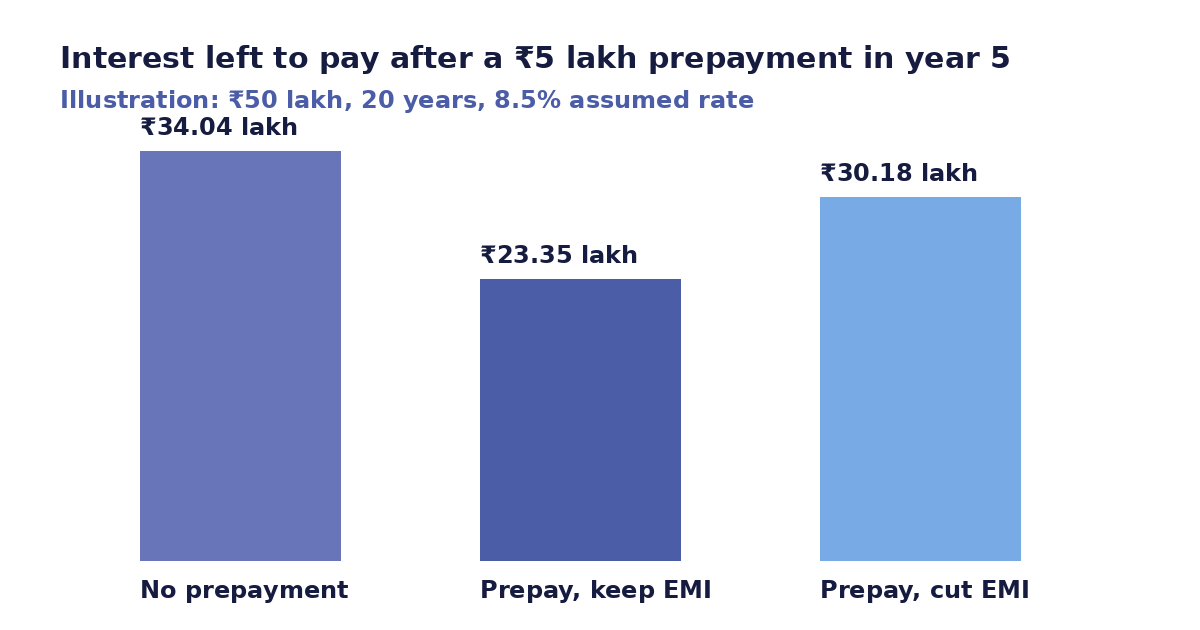
All figures are MoneyKarma calculations using the standard reducing-balance EMI formula at an assumed 8.5%.
If your monthly budget is comfortable, cutting the tenure saves far more. If cash flow is tight, a lower EMI gives you breathing room. Either way, earlier prepayments save more, because interest is heaviest in the first years of a home loan.
Does the rate itself matter?
Yes. The higher your rate, the more each prepaid rupee saves. The lowest starting rate we found on 9 October 2026 was 7.00% at a public-sector bank, for salaried borrowers with a credit score of 800 or more (lender's published rate card, checked 9 October 2026). If you are paying well above that, compare prepaying with moving the loan.
Before you prepay, check these
- Keep an emergency fund of a few months of expenses aside. Money paid into a home loan is hard to get back quickly.
- If you claim tax deductions on home loan interest or principal, a smaller loan means a smaller deduction. Work out the net saving.
- Ask whether your lender has a minimum part-payment amount for processing. That is an operational rule, not a charge.
- Get a revised repayment schedule in writing after every part payment.
- If a lender still asks for a charge on a floating-rate loan, ask them to point to it in your key fact statement, then escalate through the lender's grievance process and, if needed, the RBI Ombudsman.
Prepay or switch lenders?
Prepaying is one way to cut interest. Moving the loan to a lender with a lower rate is another, and with no prepayment charges on floating-rate loans, the old lender cannot penalise you for leaving. Count the new lender's processing, legal and valuation fees before you switch.