What You'll Learn
- Where home loan interest rates start today, by lender type, after RBI's 7 October 2026 repo hike
- Why the rate on a lender's website may not include the hike yet
- What a 0.25% change does to the EMI on a ₹50 lakh loan
- How to compare one bank's offer against another's without being misled by headline rates
Home loan interest rates today start at about 7.00% a year for the strongest borrowers. As of early October 2026, after the 7 October repo rise to 5.50%, published starting rates at public-sector banks still begin around 7.00% for top profiles (Mint, October 2026; MoneyKarma rate check 9 October 2026). Some lenders have already moved their repo-linked benchmarks; others have not yet republished, so the rate you're offered can change quickly. This guide is from MoneyKarma, India's home loan platform with 90+ lenders. Not a lender.
Key takeaway: The lowest published starting rate in October 2026 is 7.00%, at a public-sector bank, for top credit profiles. On a ₹50 lakh, 20-year loan, every 0.25% is worth roughly ₹750 a month in EMI.
What are home loan interest rates today?
Here's where published starting rates sat in early October 2026, grouped by lender type. These are floors for the best profiles, not what most borrowers get.
| Lender type | Lowest published starting rate | Source and date |
|---|---|---|
| Public-sector banks | 7.00% to 7.35% across the 12 banks listed | Mint, October 2026 |
| Private banks | From 7.25% at the lowest; 7.60% to 8.75% at the large private banks we track | Economic Times, October 2026; MoneyKarma rate check, 9 October 2026 |
| Housing finance companies | 7.15% to 8.00% at the four we track | MoneyKarma rate check, 9 October 2026 |
The top of each range matters as much as the bottom. Upper ends ran to about 10.75% in Mint's public-sector table, and to about 13% or more at some private lenders and housing finance companies in our own check. Where you land depends on your credit score, income type, loan size and the share of the property's value you borrow.
For the full dated table by lender, see home loan interest rates on moneykarma.com.
What changed on 7 October 2026?
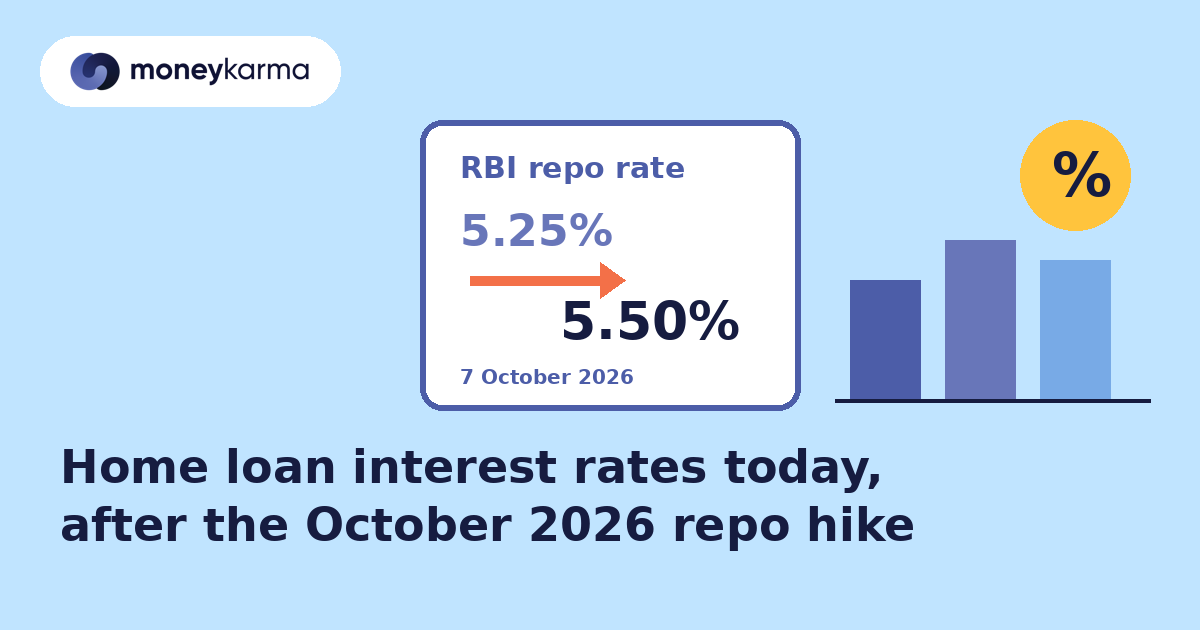
RBI's Monetary Policy Committee raised the repo rate by 0.25 percentage points, from 5.25% to 5.50%, on 7 October 2026.
Most new floating-rate home loans are linked to an external benchmark, usually the repo rate. The lender adds a fixed spread to arrive at a benchmark rate, then a further spread based on your profile. When the repo rate rises, the benchmark rises with it.
Several public-sector banks raised their repo-linked lending rates by the full 0.25% with effect from 7 or 8 October 2026 (Economic Times, October 2026). In our own 9 October check, some lenders' rate pages already showed benchmarks revised from 8 October, while others still quoted the old 5.25% repo. A rate card that hasn't been updated can understate what you'll actually be offered.
When will my existing EMI change?
Under RBI's 2019 rules on external benchmark lending, banks must reset the rate on these loans at least once every three months. Your agreement names the reset dates. Many lenders keep your EMI the same and stretch the tenure instead, so check which option applies and whether you can choose.
How much does a 0.25% rate change cost you?
Take a ₹50 lakh loan over 20 years. These are MoneyKarma calculations using the standard reducing-balance EMI formula. The rates are for illustration, starting from the lowest verified 7.00%.
| Rate | Monthly EMI | Total interest over 20 years |
|---|---|---|
| 7.00% | ₹38,765 | ₹43.04 lakh |
| 7.25% | ₹39,519 | ₹44.85 lakh |
| 7.50% | ₹40,280 | ₹46.67 lakh |
| 8.00% | ₹41,822 | ₹50.37 lakh |
| 8.50% | ₹43,391 | ₹54.14 lakh |
Going from 7.00% to 7.25% adds ₹754 a month, or about ₹1.81 lakh in interest over 20 years. The gap between 7.00% and 8.50% is ₹4,626 a month and more than ₹11 lakh over the loan's life.
A worked example
Meera, a schoolteacher in Hyderabad, has a ₹50 lakh floating-rate loan at 7.25%, paying ₹39,519 a month. If her lender passes on the full 0.25% at her next reset, her rate becomes 7.50% and her EMI would rise by about ₹761 to ₹40,280, if she keeps the original 20 years. If the lender holds her EMI flat instead, she pays for longer.
For Meera, it's worth checking whether her spread is higher than what new borrowers with her credit score are being offered. If it is, a lower spread from her own lender or a balance transfer can offset the hike.
Bank vs bank: why do starting rates differ by loan size?
Many rate tables, including Mint's October 2026 list, split rates into three loan slabs: up to ₹30 lakh, ₹30 lakh to ₹75 lakh, and above ₹75 lakh. Most public-sector banks in that table quoted the same starting rate across all three. A few didn't:
| Loan slab | Public-sector bank A | Public-sector bank B |
|---|---|---|
| Up to ₹30 lakh | 7.25% | 7.25% |
| ₹30 lakh to ₹75 lakh | 7.25% | 7.25% |
| Above ₹75 lakh | 7.20% | 7.15% |
Source: Mint, October 2026. We've left the banks unnamed; the point is the pattern.
So the bank with the lowest headline rate isn't automatically the cheapest at your loan size. A lender that starts at 7.25% for small loans may beat another's rate once you cross ₹75 lakh.
Credit score matters even more. In our 9 October 2026 check, several of the lowest published rates applied only to borrowers with a credit score of 800 or 825 and above. Some were limited to salaried applicants or women borrowers. If your score is lower, expect a higher spread.
How to compare home loan rates bank vs bank
Headline rates are a starting point. Before you pick a lender, ask each one for:
- The benchmark it uses, and whether it already reflects the 5.50% repo rate
- The spread over that benchmark for your credit score, income type and loan size
- How often the rate resets, and whether a hike changes your EMI or your tenure
- Processing fees and other charges, all listed in the Key Facts Statement
- Whether the quote holds if your loan amount or property value changes
Put the answers side by side for the same loan amount and tenure. Then run each rate through the EMI calculator and confirm how much you can borrow on the eligibility page.