What You'll Learn
- How much home loan you can get on a ₹80,000, ₹1 lakh or ₹1.2 lakh salary in Bengaluru, at rates checked on 27 October 2026
- Why no lender can fund 80% of a ₹1 crore flat, and what that means for your down payment
- Karnataka's stamp duty and registration charges after the 2025 fee increase, in rupees
- What Bengaluru's Q3 2026 housing data says about prices
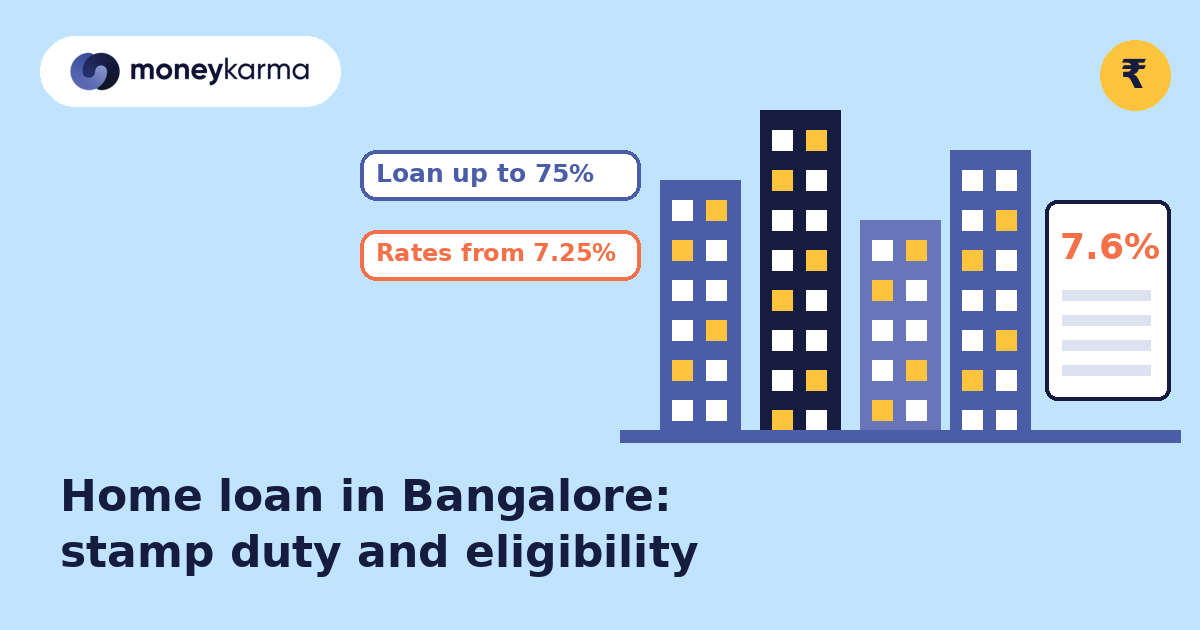
On a ₹1 crore flat in Bengaluru, the most any bank or housing finance company can lend you is ₹75 lakh, and you pay about ₹7.6 lakh in stamp duty and registration on top, in cash. That makes your own money about ₹32.6 lakh before interiors or brokerage. Home loan rates don't change by city: the lowest we found on lenders' own pages on 27 October 2026 was 7.25% at a public-sector bank. This guide comes from MoneyKarma, India's home loan platform with 90+ lenders. Not a lender.
Key takeaway: Karnataka's property charges total 7.6% of the property value since 31 August 2025, when the registration fee doubled from 1% to 2%. On a ₹1 crore home that is ₹7.6 lakh, and no lender can finance it.
How much home loan can I get on my salary in Bangalore?
Lenders look at two limits and give you the lower one: how much EMI your income can carry, and how much of the property's value they are allowed to fund.
The first limit depends on FOIR, the share of your monthly income that can go to all EMIs together. RBI does not set one FOIR number; each lender has its own policy. The table below uses 50% purely as an illustration, with no other EMIs. These are MoneyKarma calculations using the standard reducing-balance EMI formula.
| Monthly salary | EMI at 50% FOIR | Loan at 7.25%, 20 years | Loan at 7.25%, 30 years | Loan at 8.00%, 20 years |
|---|---|---|---|---|
| ₹80,000 | ₹40,000 | ₹50.6 lakh | ₹58.6 lakh | ₹47.8 lakh |
| ₹1 lakh | ₹50,000 | ₹63.3 lakh | ₹73.3 lakh | ₹59.8 lakh |
| ₹1.2 lakh | ₹60,000 | ₹75.9 lakh | ₹88.0 lakh | ₹71.7 lakh |
The 7.25% rate is for the strongest profiles: salaried, with a credit score of 800 or more, at the public-sector bank with the lowest rate we found. The same bank charged 7.50% for scores of 750 to 799 and 8.00% for 700 to 724. A lower score shrinks your loan, as the 8.00% column shows.
A spouse's income as co-applicant can raise the first limit. It cannot raise the second.
You can check your own numbers on MoneyKarma's home loan eligibility page.
Can a lender fund 80% of a ₹1 crore flat in Whitefield?
No. RBI caps how much of a home's value a lender can fund, based on the loan size:
| Loan amount | Maximum loan as a share of property value |
|---|---|
| Up to ₹30 lakh | 90% |
| Above ₹30 lakh to ₹75 lakh | 80% |
| Above ₹75 lakh | 75% |
An ₹80 lakh loan on a ₹1 crore flat would fall in the top band, where the cap is 75%. So the most you can borrow is ₹75 lakh, and the down payment is at least ₹25 lakh. These limits come from RBI's housing loan rules for banks, updated 1 October 2026, and similar rules for housing finance companies. They are the same in every city.
Stamp duty and registration are not counted in the property value for this purpose, except for homes costing up to ₹10 lakh. In Bengaluru that means you pay them yourself.
What would Rahul need in cash?
Meet Rahul, 32, a product manager earning ₹1.2 lakh a month, buying a ready-to-move ₹1 crore two-bedroom flat in Whitefield.
| Item | Amount |
|---|---|
| Home loan (75% cap) | ₹75 lakh |
| Down payment | ₹25 lakh |
| Stamp duty, cess, surcharge and registration (7.6%) | ₹7.6 lakh |
| Cash needed before interiors and brokerage | ₹32.6 lakh |
| EMI on ₹75 lakh at 7.25%, 20 years | ₹59,278 |
His EMI would take 49.4% of his salary, right at our illustrative 50% FOIR. At 8.00% the EMI would be ₹62,733, so a lender would likely offer less or suggest a longer tenure. Over 30 years at 7.25% the EMI falls to ₹51,163, but he pays far more interest.
What are stamp duty and registration charges in Bangalore?
Karnataka's charges on a home purchase add up to 7.6% of the property's guidance value. The state's Revenue Department doubled the registration fee from 1% to 2% from 31 August 2025 (notification RD/46/MNMU/2025, dated 29 August 2025). Stamp duty, cess and surcharge did not change.
| Charge | Rate | On a ₹60 lakh home | On a ₹1 crore home |
|---|---|---|---|
| Stamp duty | 5% | ₹3,00,000 | ₹5,00,000 |
| Cess | 0.5% | ₹30,000 | ₹50,000 |
| Surcharge | 0.1% | ₹6,000 | ₹10,000 |
| Registration fee | 2% | ₹1,20,000 | ₹2,00,000 |
| Total | 7.6% | ₹4,56,000 | ₹7,60,000 |
Confirm the exact amount for your property on the state's Kaveri registration portal before you budget, since it uses the guidance value for your area.
What about a ₹60 lakh ready-to-move flat?
A ₹48 lakh loan is 80% of a ₹60 lakh flat, inside the 80% cap for loans above ₹30 lakh. At 7.25%, the EMI on ₹48 lakh would be:
| Tenure | EMI |
|---|---|
| 15 years | ₹43,817 |
| 20 years | ₹37,938 |
| 25 years | ₹34,695 |
| 30 years | ₹32,744 |
Your cash outlay would be the ₹12 lakh down payment plus ₹4.56 lakh in charges, about ₹16.6 lakh. We found no state incentive on the registration fee that would raise the loan amount; the fee went up in 2025, not down.
What is happening to Bengaluru home prices?
Prices are rising faster than sales. Knight Frank's India residential report for July to September 2026 shows Bengaluru with:
- 15,172 homes sold in Q3 2026, up 4% from a year earlier
- 18,393 homes launched, up 3%
- Weighted average prices up 11% year on year and 5% over the previous quarter
Rising prices make the 75% cap bite harder. As an illustration, a flat that rose from ₹90 lakh to ₹1 crore in a year now needs ₹25 lakh down instead of ₹22.5 lakh.
Do Bangalore lenders charge different rates?
No. Banks and housing finance companies price home loans the same way across cities: a benchmark rate, usually linked to the RBI repo rate of 5.50%, plus a spread based on your credit score, income type and loan size. On 27 October 2026, starting rates at four public-sector banks were 7.25%, 7.40%, 7.45% and 7.50%. What changes between lenders is the spread, the processing fee and the paperwork they ask for, so compare offers rather than looking for a "Bangalore rate". See today's home loan interest rates on moneykarma.com.
For a salaried buyer, a typical file needs KYC, three to six months' salary slips, bank statements, Form 16 and the property papers. Lenders run legal and technical checks on the property, so a builder project they have already approved can move faster.
Can Rahul claim tax on the interest?
Yes, under the old regime. Section 22 of the Income-tax Act, 2025 lets him deduct up to ₹2 lakh a year of interest on a self-occupied home. His first-year interest on ₹75 lakh at 7.25% is about ₹5.38 lakh, well above the cap. The new regime gives no such deduction for a self-occupied home.