What You'll Learn
- The EMI on a ₹30 lakh, ₹50 lakh, ₹75 lakh and ₹1 crore home loan over 15 to 30 years, at rates checked on 23 October 2026
- Whether a bigger loan or a 30-year tenure changes the rate you're offered
- The income lenders will want to see for each loan size
- How a small yearly prepayment shortens a 30-year loan
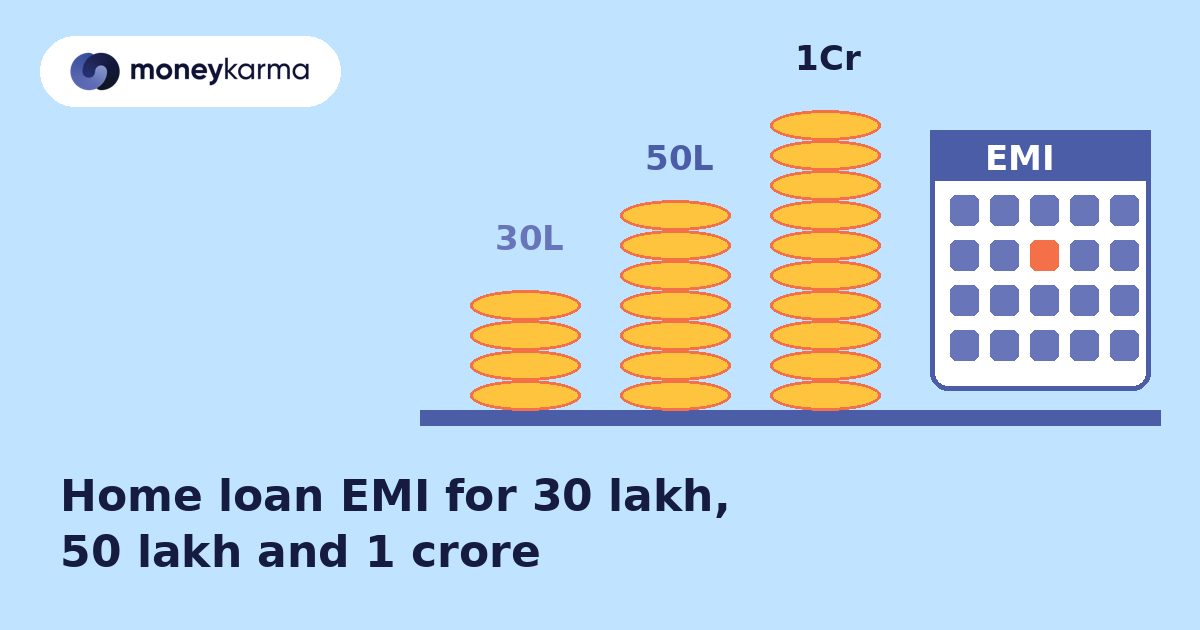
At the lowest home loan rate we found on 23 October 2026, 7.25% at a public-sector bank, the EMI on a ₹30 lakh loan for 20 years is ₹23,711. A ₹50 lakh loan over 20 years costs ₹39,519 a month, and a ₹1 crore loan ₹79,038. That rate is for salaried borrowers with a credit score of 800 or more; at 7.50%, a common starting rate on other public-sector bank cards, add about ₹460, ₹760 and ₹1,520 a month. This guide comes from MoneyKarma, India's home loan platform with 90+ lenders. Not a lender.
Key takeaway: At 7.25%, every ₹1 lakh you borrow over 20 years costs about ₹790 a month. Stretching a ₹1 crore loan from 20 to 30 years cuts the EMI by ₹10,820 but adds about ₹56 lakh in interest.
What is the EMI on a ₹30 lakh home loan for 20 years?
₹23,711 a month at 7.25%, and ₹24,168 at 7.50%. Over 20 years you'd repay about ₹26.9 lakh in interest at 7.25% on top of the ₹30 lakh you borrowed.
All EMIs in this guide are MoneyKarma calculations using the standard reducing-balance formula, the same one the home loan EMI calculator uses. Your lender's figure may differ by a few rupees because of rounding and the date your first EMI falls.
Home loan EMI by loan amount and tenure
EMIs at 7.25%, the lowest published rate we found on lenders' own pages on 23 October 2026:
| Loan amount | 15 years | 20 years | 25 years | 30 years |
|---|---|---|---|---|
| ₹30 lakh | ₹27,386 | ₹23,711 | ₹21,684 | ₹20,465 |
| ₹50 lakh | ₹45,643 | ₹39,519 | ₹36,140 | ₹34,109 |
| ₹75 lakh | ₹68,465 | ₹59,278 | ₹54,211 | ₹51,163 |
| ₹1 crore | ₹91,286 | ₹79,038 | ₹72,281 | ₹68,218 |
For any other amount, use EMI per ₹1 lakh: ₹913 over 15 years, ₹790 over 20, ₹723 over 25 and ₹682 over 30, at 7.25%. A ₹42 lakh loan over 20 years works out to about 42 × ₹790, or ₹33,180.
What is the EMI on a ₹1 crore home loan?
₹79,038 a month over 20 years at 7.25%, or ₹68,218 over 30 years. At 7.50%, the 20-year EMI is ₹80,559. On a loan this size, each 0.25% of rate is worth about ₹1,520 a month.
Do bigger loans get a lower interest rate?
At some banks, slightly. One public-sector bank's card, checked on 23 October 2026 with its benchmark at 8.25% from 9 October 2026, prices its best credit grade like this:
| Loan amount | Rate (women borrowers) | Rate (other borrowers) |
|---|---|---|
| Up to ₹50 lakh | 7.50% | 7.55% |
| Above ₹50 lakh to ₹1 crore | 7.45% | 7.50% |
| Above ₹1 crore | 7.40% | 7.45% |
Other cards ignore the amount. A second public-sector bank's rate sheet, effective 8 October 2026, says its home loan rates apply irrespective of loan amount, starting at 7.40% for a score of 825 or more. The bank with the lowest rate, 7.25%, shows a single card by credit score with no loan slabs.
So the gap between a ₹30 lakh and a ₹1 crore loan is usually 0.10% or less. Your credit score moves the rate far more. You can compare home loan interest rates across Indian banks on MoneyKarma.
What about home loans above ₹75 lakh?
The rate doesn't go up at the banks we checked, but the down payment does. RBI caps home loans above ₹75 lakh at 75% of the property's value, against 80% for loans above ₹30 lakh up to ₹75 lakh. To borrow ₹1 crore, the home has to be worth at least about ₹1.34 crore, and stamp duty and registration are usually excluded from that value.
Does a 30-year tenure cost a higher rate?
Not at the public-sector banks we checked. The 7.25% lender offers up to 30 years or until you turn 75, whichever comes first, on the same rate card. The cost of a long tenure shows up in total interest, not in the rate.
| ₹1 crore at 7.25% | EMI | Total interest |
|---|---|---|
| 20 years | ₹79,038 | ₹89.7 lakh |
| 25 years | ₹72,281 | ₹1.17 crore |
| 30 years | ₹68,218 | ₹1.46 crore |
Going from 20 to 30 years saves ₹10,820 a month and costs about ₹56 lakh more in interest. Age matters too: a 40-year-old at a bank with a 75 age limit can still get 30 years, but a 50-year-old can't.
How much salary do you need for each loan?
Lenders limit how much of your income can go to EMIs. Assume a cap of 50% of net monthly income, which is an illustrative figure since lenders set their own limits. At 7.25% over 20 years:
- ₹30 lakh needs about ₹47,400 a month of net income
- ₹50 lakh needs about ₹79,000
- ₹1 crore needs about ₹1.58 lakh
Existing EMIs on a car or personal loan come out of that limit first. A 30-year tenure lowers the income needed. Check what you qualify for on the home loan eligibility page.
A worked example: take 30 years, prepay every year
Rohan and Shruti, both salaried in Pune, are buying a ₹1.35 crore flat with a ₹1 crore loan at 7.25%. They take 30 years to keep the EMI at ₹68,218, but plan to prepay ₹2 lakh at the end of each year from their bonuses. These are MoneyKarma calculations; the price, rate and prepayment plan are illustrative assumptions.
With that one change, the loan closes in about 17 years and 7 months instead of 30. Total interest falls from about ₹1.46 crore to about ₹77.6 lakh, a saving of roughly ₹68 lakh. Under RBI rules, banks can't charge individuals for prepaying a floating-rate home loan, so the flexibility costs nothing extra.
Can you claim tax on that interest?
Only up to a limit, and only under the old regime. Under the Income-tax Act, 2025, section 22 allows up to ₹2 lakh a year of interest on a self-occupied home. On a ₹1 crore loan at 7.25%, first-year interest is about ₹7.2 lakh, so most of it gets no tax relief. Joint owners who both pay the EMI can each claim up to the cap.