What You'll Learn
- Whether to reduce your EMI or your tenure after a home loan part-prepayment
- A worked example on a ₹50 lakh loan, with the interest saved under each choice
- What RBI's rules let you choose when your rate resets, as it did after the October 2026 repo hike
- When lowering the EMI is the smarter call
If you can afford your current EMI, reduce the tenure. After a part-prepayment, keeping the EMI the same and letting the loan end sooner almost always saves far more interest than lowering the EMI. On a ₹50 lakh, 20-year loan at 8.00%, a ₹5 lakh prepayment in year four saves about ₹11.95 lakh in interest if you cut the tenure, against about ₹4.16 lakh if you cut the EMI. This guide shows the math and the cases where the EMI route wins. It comes from MoneyKarma, India's home loan platform with 90+ lenders. Not a lender.
Key takeaway: Reducing tenure saved nearly three times as much interest as reducing EMI in our ₹50 lakh example. Choose the lower EMI only if you need the monthly cash, and tell your lender your choice in writing when you prepay.
What happens when you prepay a home loan?
A part-prepayment goes straight to your principal. Since interest is charged on the outstanding balance, every later EMI carries less interest and more principal. Your lender then has to recalculate the loan in one of two ways:
- Keep the EMI, shorten the tenure. You pay the same each month and finish earlier.
- Keep the tenure, lower the EMI. You finish on the original date and pay less each month.
Some lenders apply one of these by default. Check your loan agreement or ask the branch before you pay, because changing it afterwards can take a fresh request.
On a floating-rate home loan taken by an individual, banks and housing finance companies can't charge for prepayment. RBI first set this for banks in 2012, NHB extended it to housing finance companies in 2014, and RBI's Pre-payment Charges Directions of 2 July 2025 cover all regulated lenders for loans from 1 January 2026. Fixed-rate loans can still carry a charge, so read your Key Facts Statement.
Reduce EMI or reduce tenure: a worked example
Arvind took a ₹50 lakh home loan in Hyderabad at 8.00% for 20 years. His EMI is ₹41,822. After 36 EMIs, he still owes about ₹46.56 lakh, and he gets a ₹5 lakh bonus that he puts into the loan, bringing the balance down to about ₹41.56 lakh.
The 8.00% rate is an illustrative assumption. All figures are MoneyKarma calculations using the standard reducing-balance EMI formula, assuming the rate doesn't change.
| ₹50 lakh at 8.00%, 20 years | No prepayment | Prepay ₹5 lakh, keep EMI | Prepay ₹5 lakh, keep tenure |
|---|---|---|---|
| Monthly EMI after year 3 | ₹41,822 | ₹41,822 | ₹37,331 |
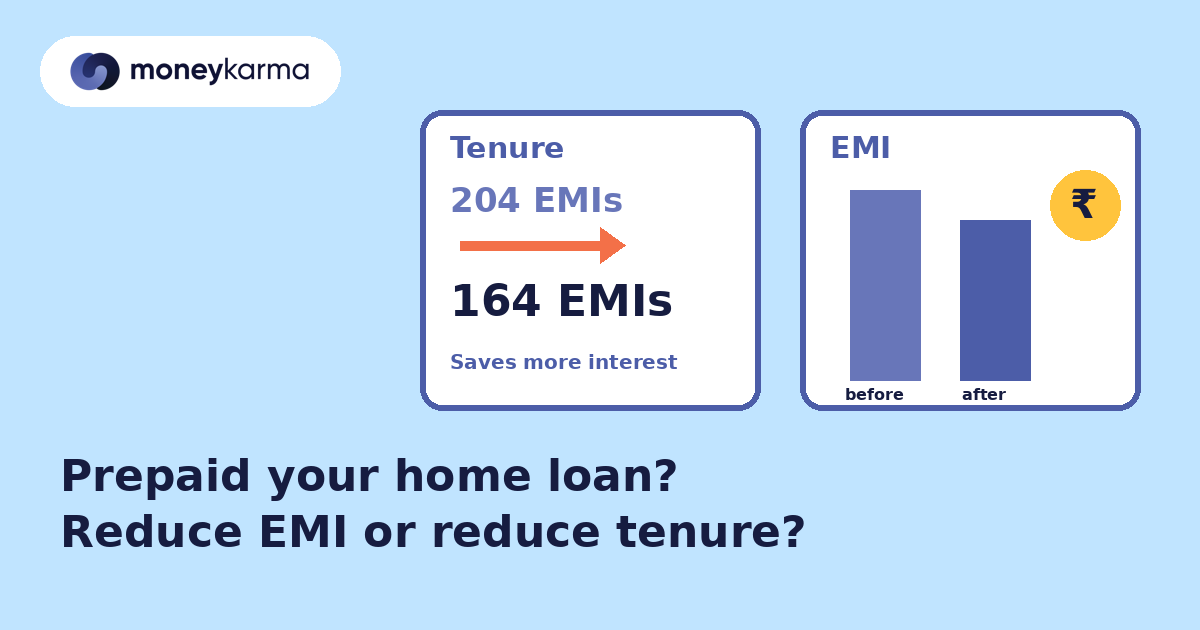
| EMIs left after prepayment | 204 | 164 | 204 |
| Total interest over the loan | ₹50.37 lakh | ₹38.42 lakh | ₹46.21 lakh |
| Interest saved | None | About ₹11.95 lakh | About ₹4.16 lakh |
Keeping the EMI cuts 40 EMIs, or three years and four months, off Arvind's loan. Cutting the EMI instead leaves him ₹4,491 more each month, but saves only about a third as much interest.
Why does reducing tenure save more?
When you keep the EMI, the extra money each month keeps going to principal, so the balance falls faster and the interest shrinks every month after. When you lower the EMI, you're spreading the smaller balance over the same long period, so interest keeps building for all 17 remaining years.
What does a repo rate hike do to your EMI or tenure?
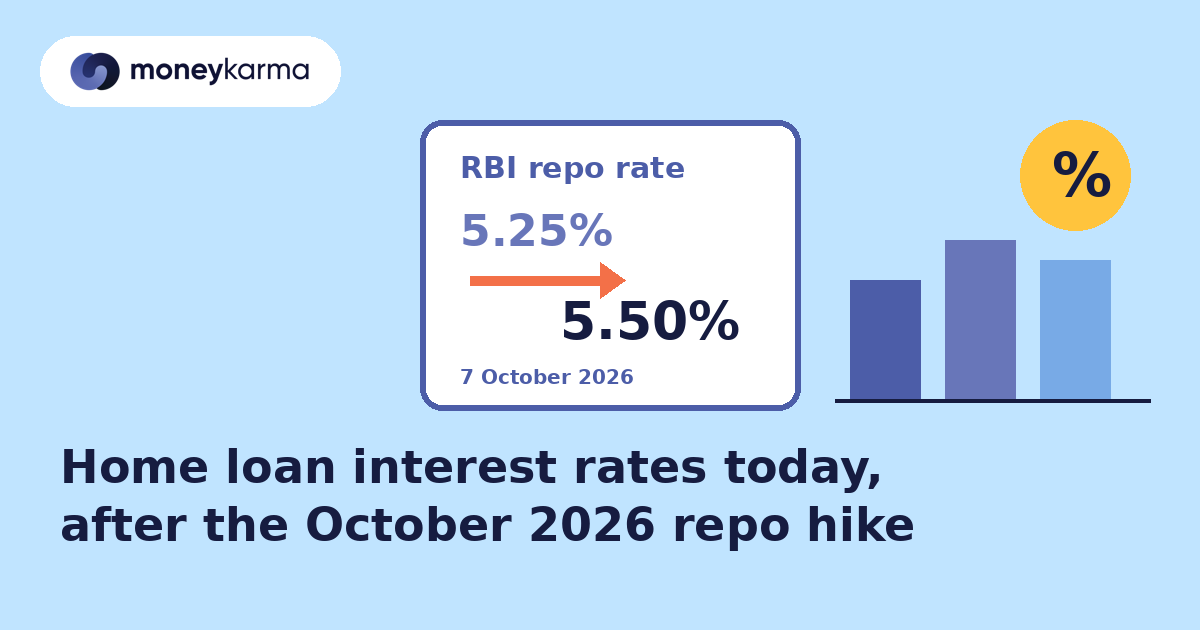
This matters right now. RBI raised the repo rate from 5.25% to 5.50% on 7 October 2026, and banks have been raising repo-linked home loan rates by 0.25%. Many lenders keep the EMI the same and extend the tenure by default.
In Arvind's case, if his rate rises from 8.00% to 8.25% at the start of year four and he doesn't prepay, his remaining tenure grows from 204 EMIs to about 212, roughly eight months more. If he asks for the EMI to go up instead, it rises by ₹696 a month to ₹42,518.
RBI's August 2023 circular on resetting floating rates, updated on 1 October 2025, says lenders must offer you a choice at reset: a higher EMI, a longer tenure or a mix of both, and the option to prepay in part or in full at any point. Lenders must also tell you about any change to your EMI or tenure straight away, and send a statement every quarter.
Combining a prepayment with a rate rise
If Arvind prepays ₹5 lakh after the hike and keeps his EMI, he'd still finish in about 168 EMIs, well ahead of the original 204. A prepayment is the simplest way to cancel out a tenure extension.
When is reducing the EMI the better choice?
Reducing tenure wins on interest, but it isn't always right. Lower the EMI if:
- Your EMI takes up a large share of your take-home pay and you need room for other costs
- Your income is irregular, as it is for many self-employed borrowers
- You're about to take on another loan, such as a car loan, and want to stay within the lender's income limits
- You have no emergency fund. Money in the bank is easier to reach than money in your loan
There's also a middle path. Lower the EMI after prepaying, then keep paying the old amount voluntarily as extra prepayments when you can. You keep most of the interest saving and get a cushion for bad months, as long as your lender accepts regular part-payments.
Does prepaying reduce your tax benefit?
Only a little, and often not at all in the early years. Under the old tax regime, interest on a self-occupied home is deductible up to ₹2 lakh a year, under section 22 of the Income-tax Act, 2025, which carries over the old Section 24(b). In year four, even after the prepayment, Arvind pays about ₹3.26 lakh of interest under either option, still well above the ₹2 lakh cap. So the prepayment costs him nothing in deductions that year. Under the new tax regime, the default, there's no interest deduction on a self-occupied home anyway. Check your own case with a tax adviser.
Should you prepay at all, or invest the money?
Compare your loan rate with the after-tax return you can reasonably expect, and be honest about risk. Prepaying a loan at 8.00% gives you a certain 8.00% return. If your rate is high, a balance transfer to a lower rate may do more than a prepayment. The lowest starting home loan rate in MoneyKarma's 9 October 2026 check was 7.00%, at a public-sector bank, for top credit profiles.