What You'll Learn
- Home loan interest rates for self-employed borrowers vs salaried, from lenders' own pages on 24 October 2026
- How lenders read a business owner's ITR to decide the loan amount
- The documents self-employed applicants need, and the eligibility rules
- A worked example for a business owner buying a ₹90 lakh flat
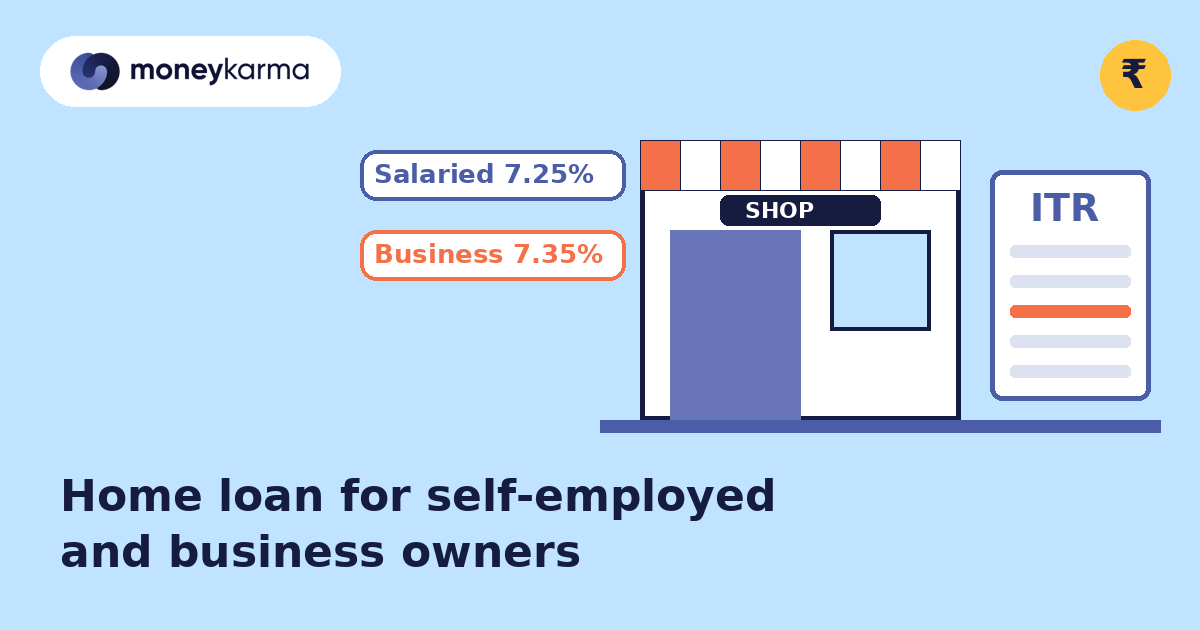
Self-employed borrowers pay almost the same home loan rate as salaried ones. On lenders' rate pages checked on 24 October 2026, the gap was 0.00% to 0.15% at the banks we looked at: one public-sector bank charges 7.35% to a non-salaried borrower with a credit score of 800 or more, against 7.25% for a salaried one, the lowest rate we found that day. The harder part is the loan amount, because lenders size it on the income in your ITR, not your turnover. This guide comes from MoneyKarma, India's home loan platform with 90+ lenders. Not a lender.
Key takeaway: For a business owner, the rate gap with salaried borrowers is about 0.10%. On a ₹50 lakh loan over 20 years that is ₹304 a month. Low declared income in your ITR costs far more.
Home loan interest rate for self-employed: how does it compare?
Here is what lenders' own rate pages showed on 24 October 2026. Lenders aren't named. These are floating rates linked to the RBI repo rate, which is 5.50% after the 7 October 2026 increase.
| Lender type | Salaried | Self-employed | Credit score band |
|---|---|---|---|
| Public-sector bank A | 7.25% | 7.35% | 800 and above |
| Public-sector bank A | 7.50% | 7.60% | 750 to 799 |
| Public-sector bank B | 7.40% | 7.40% | 825 and above |
| Public-sector bank B | 7.60% | 7.65% | 750 to 799 |
| Private bank A | 8.75% | 8.85% | 750 to 800 |
| Private bank B | 8.00% to 8.85% | 8.00% to 8.85% | 751 and above |
| Private bank C | 8.00% to 13.45% | 8.00% to 13.45% | By profile |
| Housing finance company | Not compared | From 8.80% | By profile |
Two of the private banks publish one range for both groups. Private bank A's wider slabs show the self-employed paying up to 0.15% more at the top of each range: 9.80% against 9.65% for loans up to ₹35 lakh, for example. You can check home loan interest rates across Indian banks on MoneyKarma.
Why do self-employed borrowers pay a little more?
Business income moves around more than a salary and is harder to verify. Lenders price that in, but only slightly. Your credit score moves the rate far more: at public-sector bank A, a non-salaried borrower pays 7.35% at 800 or more and 8.20% at 700 to 724.
How do lenders work out a business owner's eligibility from the ITR?
They start from the income you declared to the tax department, not your sales. Many lenders average your net income over the last two or three ITRs, add back items such as depreciation where their policy allows, and then check how much of that monthly income is already going to EMIs. What's left decides your EMI and so your loan.
Two things follow. If you claimed heavy expenses to keep taxable income low, your eligible loan shrinks with it. And a one-year jump in profit may be averaged down, so file steady returns for a couple of years before you apply.
The loan is then capped by the property's value. RBI limits for housing loans are 90% of value up to ₹30 lakh, 80% above ₹30 lakh to ₹75 lakh and 75% above ₹75 lakh. Stamp duty and registration are usually yours to pay. MoneyKarma's home loan eligibility guide explains the income side in more detail.
Who is eligible for a self-employed home loan?
On the pages we checked on 24 October 2026:
- Who can apply: public-sector bank A lends to salaried borrowers, self-employed professionals, businessmen and eligible NRIs.
- Business vintage: a housing finance company asks for at least three years of business continuity and ITR filing.
- Age: 21 at the start to 70 at maturity at the housing finance company; public-sector bank A allows tenures up to 30 years or age 75.
- Credit score: the housing finance company's floor is 611, but rates at every lender rise sharply below 750.
Home loan documents for self-employed applicants
A private bank's list for self-employed professionals and non-professionals is typical:
- ITRs with computation of income for at least the last two assessment years, for you and the business, attested by a CA
- Balance sheet and profit and loss account for the last two years, with schedules, also CA-attested
- Last 12 months' current account statements of the business and savings account statements of the individual
- Business profile, latest Form 26AS, and for a company, the list of directors and shareholders certified by a CA or CS
- KYC, property papers and proof of your own contribution
Missing schedules or an unsigned P&L are a common reason files stall. Get your CA to prepare the set before you start shortlisting flats.
A worked example: a Surat trader buying a ₹90 lakh flat
Imran, 41, runs a garment trading firm in Surat. His last two ITRs average ₹18 lakh net income, or ₹1.5 lakh a month, and he pays a car EMI of ₹15,000. His credit score is above 800. These are MoneyKarma calculations using the standard reducing-balance EMI formula; we assume the lender caps all EMIs at 50% of income, which varies by lender.
| Step | Figure |
|---|---|
| Monthly income from ITR | ₹1,50,000 |
| EMI room at 50%, less car EMI | ₹60,000 |
| Loan that EMI supports at 7.35%, 20 years | ₹75.3 lakh |
| RBI value cap on a ₹90 lakh flat (75%) | ₹67.5 lakh |
| Loan he can get | ₹67.5 lakh |
| EMI on ₹67.5 lakh at 7.35%, 20 years | ₹53,760 |
Here the property cap binds, not his income, so Imran needs ₹22.5 lakh of his own plus stamp duty and registration. Now suppose his ITRs had shown ₹12 lakh a year. His EMI room drops to ₹35,000 and the loan it supports at the same rate falls to ₹43.9 lakh, a gap of ₹23.6 lakh against the property cap. That is the real cost of under-declared income.
What does the 0.10% gap cost?
On a ₹50 lakh loan over 20 years, the EMI is ₹39,519 at 7.25% and ₹39,822 at 7.35%. That is ₹304 a month, or ₹72,842 over the full term.
How can a business owner get a better home loan offer?
- Add a co-applicant with steady income, such as a salaried spouse. Their income adds to eligibility, and at some banks a woman co-owner gets a small concession.
- Clear or reduce small loans before applying. A ₹15,000 EMI cut Imran's EMI room by a fifth.
- Route business receipts through one current account. Lenders read 12 months of statements and like a clear pattern.
- Check your credit score first. At public-sector bank A, a non-salaried borrower pays 7.35% at 800 or more and 7.60% at 750 to 799.