What You'll Learn
- What a loan to build a house on your own plot costs at today's rates, and why it's usually priced like a home loan
- How much the lender will fund, and why you put in your share before the first release
- What self-employed borrowers need to show, and how much more they pay
- How the build deadline affects the tax deduction on your interest
If you already own a plot and want to build on it, you need a home construction loan, not a plot loan. Most banks price it on the same rate card as a home loan to buy a flat. As of 21 October 2026, the lowest published starting rate we found was 7.25%, at a public-sector bank, for salaried borrowers with a credit score of 800 or more; self-employed borrowers at the same bank start at 7.35%. The lender funds up to 75% to 90% of the construction cost, depending on loan size, and releases it in stages as the house goes up. This guide comes from MoneyKarma, India's home loan platform with 90+ lenders. Not a lender.
Key takeaway: On a ₹40 lakh construction loan over 20 years, the gap between a 7.35% rate and an 8.20% rate is about ₹2,100 a month and ₹5 lakh in total interest. Your credit score and income papers decide which end of the range you get.
What is a home construction loan?
It's a home loan for building a house on land you already own. The land and the house are mortgaged to the lender. The money comes in parts as work moves from foundation to roof to finishing, and the lender sends an engineer to check progress before each release.
That's different from a plot loan, which pays for the land, and a composite loan, which covers buying a plot and building on it under one sanction. This post is for people who already have the plot.
What are home construction loan interest rates today?
At most banks, building a house sits under the same housing scheme and rate card as buying one. One public-sector bank's scheme lists purchase, construction, plot plus construction, extension and repair under a single scheme. So your rate depends on your credit score, income type and loan amount, not on the fact that you're building.
Here's what lenders' own rate pages showed on 21 October 2026, after banks passed on the RBI's repo rate rise to 5.50% on 7 October 2026. The table shows the lowest published rate for each case.
| Borrower profile | Public-sector bank A | Public-sector bank B | Large private bank |
|---|---|---|---|
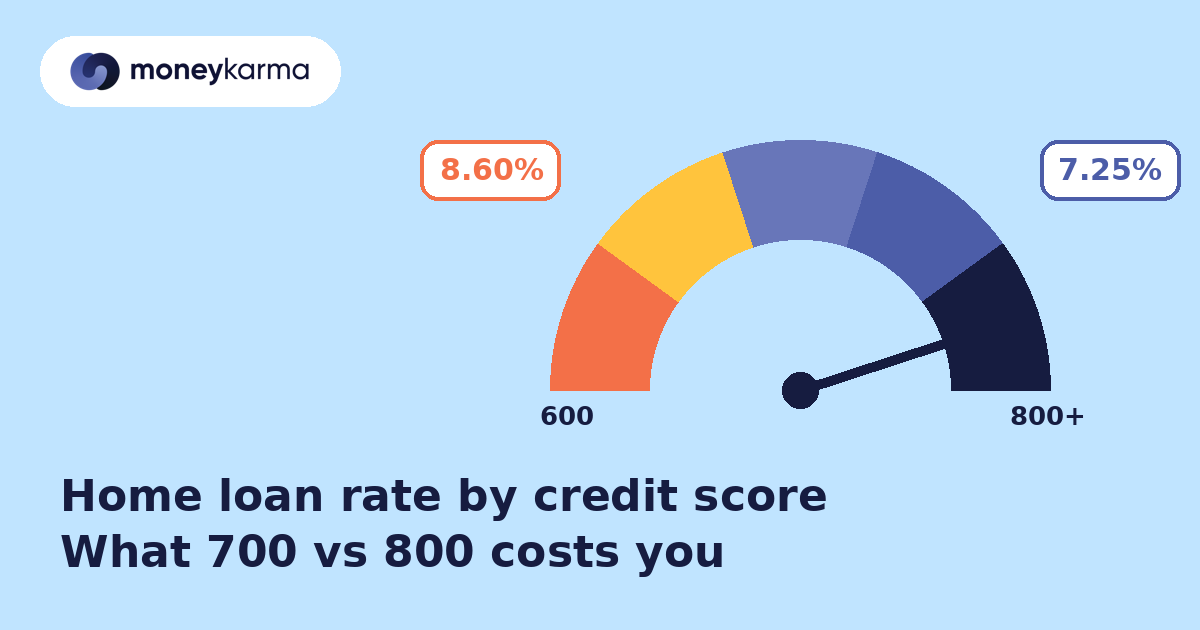
| Salaried, credit score 800 or more | 7.25% | 7.40% (825 or more) | 8.00% to 8.85% (751 or more) |
| Self-employed, credit score 800 or more | 7.35% | 7.40% (825 or more) | 8.00% to 8.85% (751 or more) |
| Salaried, credit score 750 to 799 | 7.50% | 7.60% | 8.00% to 8.85% |
| Self-employed, credit score 750 to 799 | 7.60% | 7.65% | 8.00% to 8.85% |
| Credit score 700 to 749, salaried | 7.95% to 8.00% | 8.00% | 8.20% to 9.10% |
With a score of 750 or more, self-employed borrowers pay at most 0.10 points more at the two public-sector banks. Dropping from the 750 to 799 score band to 700 to 749 costs far more than being self-employed does.
How much will the bank lend for construction?
RBI caps the loan at a share of the property's value, and for a house you're building, that value is mainly the construction cost. The caps are 90% for loans up to ₹30 lakh, 80% for loans above ₹30 lakh and up to ₹75 lakh, and 75% above ₹75 lakh. Lenders work out the cost from your approved plan and an engineer's or architect's estimate.
Your share, the margin, usually goes in first. One large private bank says it funds up to 80% of the construction cost and expects you to pay your part upfront; it releases its first instalment once it's satisfied with progress.
Does the value of my plot count?
It depends on how you got it. The same private bank says the cost of a plot you recently bought is taken into account, but the value of an inherited plot is not. If your land came from your family, plan to fund the full margin on construction in cash.
A worked example: ₹50 lakh house on your own plot
Imran runs a printing business in Hyderabad and has inherited a plot from his father. His engineer's estimate for a two-floor house is ₹50 lakh. Because the loan falls in the ₹30 lakh to ₹75 lakh band, the bank can fund up to 80%, so ₹40 lakh. He puts in ₹10 lakh of his own money first.
Say the bank releases ₹10 lakh at months 0, 4, 8 and 12, and the house is finished in month 14. Until then he pays interest only on what's been released: about ₹1.96 lakh in total at 7.35%. Then his 20-year EMI starts.
| Rate | Monthly EMI on ₹40 lakh, 20 years | Total interest |
|---|---|---|
| 7.35% | ₹31,858 | ₹36.46 lakh |
| 7.60% | ₹32,469 | ₹37.93 lakh |
| 8.20% | ₹33,957 | ₹41.50 lakh |
MoneyKarma calculations, standard reducing-balance formula. Rates match the self-employed rows above; amount and schedule are illustrative assumptions.
If Imran's credit score were 750 to 799 rather than 800 plus, he'd pay about ₹611 more a month at the first bank. At 8.20% he'd pay about ₹2,100 more a month and ₹5 lakh more over the loan.
What do self-employed borrowers need to show?
Lenders want a steady income history and proof the business has been running for a while. Typical asks on lenders' pages:
- Income tax returns for the last two to three years, with computation of income
- Profit and loss account and balance sheet, certified by a chartered accountant where required
- Six to 12 months of bank statements
- Proof that the business exists, such as GST or Udyam registration
- Business continuity of about three years at some housing finance companies
A construction loan also needs land papers: the title deed, an encumbrance certificate, the approved building plan and the cost estimate. If your declared income is low, an earning co-applicant can raise the amount you qualify for.
Is there a deadline to finish building?
Your sanction letter sets a construction period. Tax law adds its own clock. Under section 22 of the Income-tax Act, 2025, in force from 1 April 2026, you can claim up to ₹2 lakh a year of interest on a self-occupied home under the old tax regime only if construction is completed within five years from the end of the tax year in which you took the loan. Miss that and the cap drops to ₹30,000.
Interest paid before the year of completion, like Imran's ₹1.96 lakh of pre-EMI, is claimed in five equal parts starting from the year the house is finished, within the same ₹2 lakh cap. Under the new regime, which is the default, there's no interest deduction for a self-occupied home.