What You'll Learn
- What home loan rates look like for each credit score band, from lenders' own rate cards on 21 October 2026
- What a 700 to 750 score costs you compared with 800 plus, in rupees
- Why having no credit history can get you a better rate than a middling score
- What to do before you apply, and what changes on an existing loan if your score moves
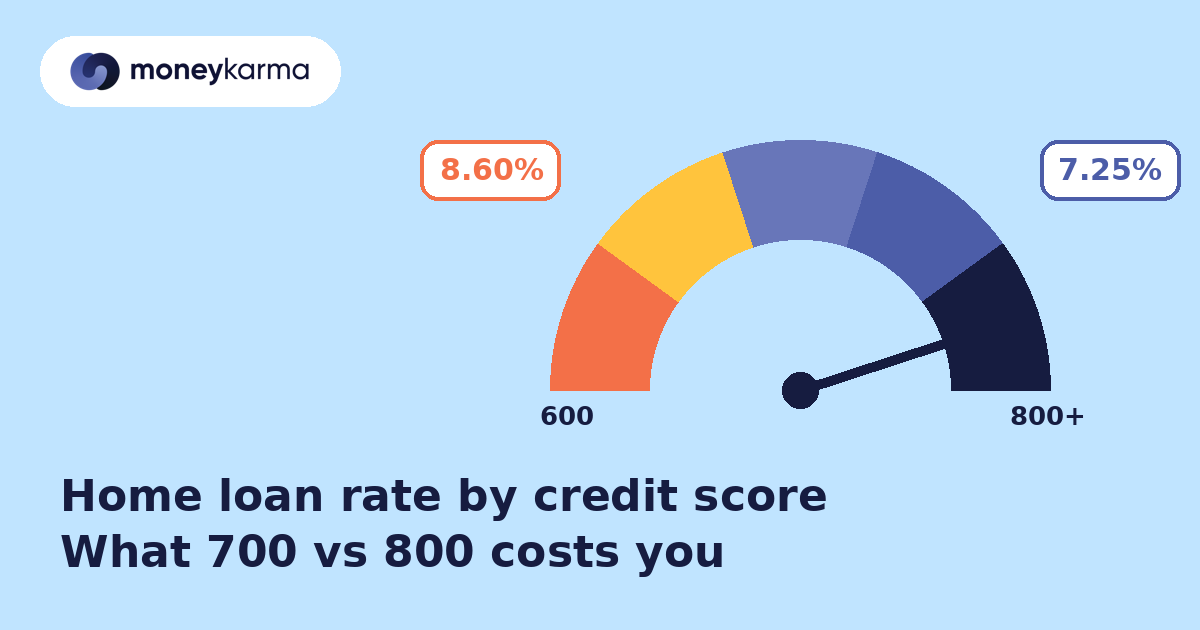
Your credit score sets which rate you're offered at most Indian banks, and the gap is bigger than many people expect. On lenders' own rate cards on 21 October 2026, a salaried borrower with a score of 800 or more could get 7.25% at a public-sector bank, while the same bank charged 8.00% for a score of 700 to 724 and 8.60% for 650 to 699. On a ₹50 lakh loan over 20 years, that 0.75-point gap between 800 plus and 700 to 724 costs about ₹2,300 a month and ₹5.5 lakh in total interest. This guide comes from MoneyKarma, India's home loan platform with 90+ lenders. Not a lender.
Key takeaway: Moving from the 700 to 749 band to 750 plus is worth more than most rate negotiations. At one public-sector bank, it cuts the rate by 0.45 to 0.50 points.
Why does your credit score change your home loan rate?
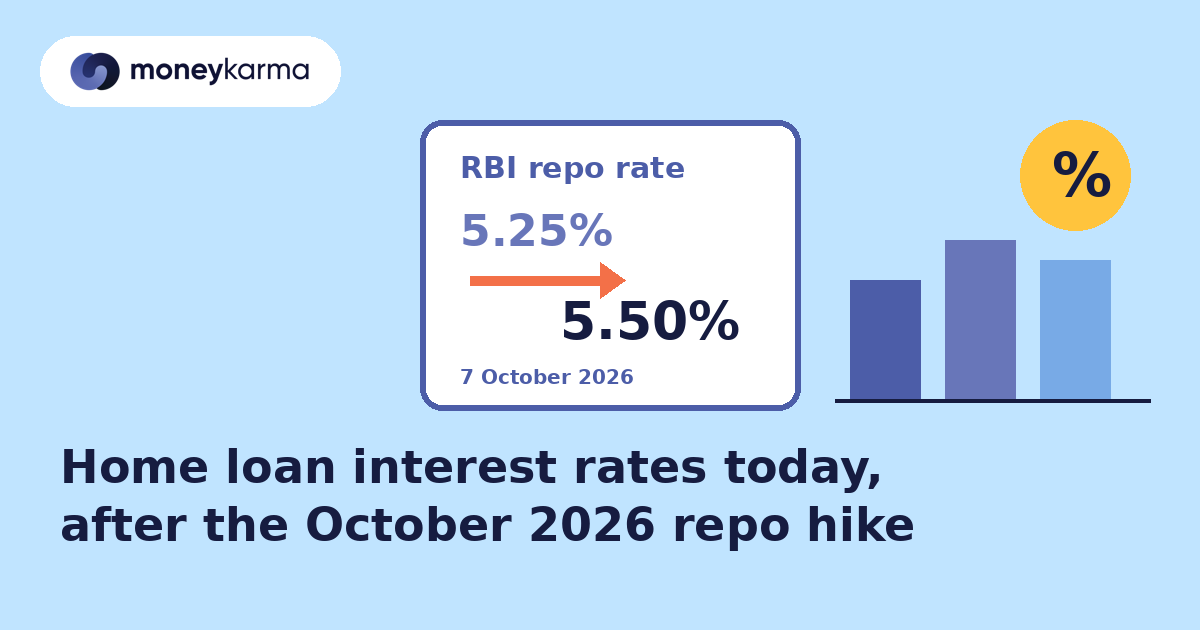
Most floating home loans from banks are linked to an external benchmark, usually the RBI repo rate, which has been 5.50% since 7 October 2026. Your rate is that benchmark, or the bank's repo-linked lending rate built on it, plus or minus a spread. Part of that spread is a credit risk premium, and banks set it using your credit score.
That's why two people who walk into the same branch on the same day can be quoted rates almost a full point apart. The bank's rate card does the sorting. Many public-sector banks now publish these bands openly, which makes it easy to see where you stand.
What are home loan rates by credit score today?
These are the lowest published rates for a salaried borrower at three lenders on 21 October 2026, taken from each lender's own rate page after the 7 October repo rate rise. Lenders aren't named.
| Credit score | Public-sector bank A | Public-sector bank B | Large private bank |
|---|---|---|---|
| 800 or more | 7.25% | 7.45% (800 to 824); 7.40% (825 or more) | 8.00% to 8.85% (751 or more) |
| 750 to 799 | 7.50% | 7.60% | 8.00% to 8.85% |
| 725 to 749 | 7.95% | 8.00% (700 to 749) | 8.20% to 9.10% (750 or below) |
| 700 to 724 | 8.00% | 8.00% | 8.20% to 9.10% |
| 650 to 699 | 8.60% | 8.25% (680 to 699); 9.10% (650 to 679) | 8.20% to 9.10% |
| 600 to 649 | 9.00% | 9.60% | Not published |
| No credit history | 7.95% | 7.65% | 8.20% to 9.10% |
A few patterns are worth noticing. The steepest step at both public-sector banks is just below 750. Self-employed borrowers pay up to 0.20 points more at the same banks in most bands. And the private bank's range is wider and higher, because its card covers more loan variants and profiles.
Why is "no credit history" priced better than a 700 score?
A first-time borrower with no loans or cards has no record of missed payments. A score of 700 to 724 usually means there's been some trouble, such as late payments or high card use. So at bank A, someone with no history pays 7.95% and someone at 700 to 724 pays 8.00%; at bank B, no history gets 7.65% against 8.00%.
What does a 700 to 750 credit score cost you?
Take Ritu, a salaried software tester in Pune who wants a ₹50 lakh loan for 20 years. Here's her EMI at bank A for each band. These are MoneyKarma calculations using the standard reducing-balance formula; the loan amount and tenure are illustrative.
| Credit score band | Rate at bank A | Monthly EMI | Total interest over 20 years |
|---|---|---|---|
| 800 or more | 7.25% | ₹39,519 | ₹44.85 lakh |
| 750 to 799 | 7.50% | ₹40,280 | ₹46.67 lakh |
| 725 to 749 | 7.95% | ₹41,667 | ₹50.00 lakh |
| 700 to 724 | 8.00% | ₹41,822 | ₹50.37 lakh |
| 650 to 699 | 8.60% | ₹43,708 | ₹54.90 lakh |
| Below 600 | 9.40% | ₹46,281 | ₹61.07 lakh |
If Ritu's score is 735, she pays about ₹2,150 a month more than she would at 800 plus, and ₹5.15 lakh more over the loan. Getting into the 750 to 799 band alone would save her about ₹1,390 a month.
How can you get into a better band before you apply?
Scores respond to recent behaviour, so a few months of clean history can help. What tends to move the number:
- Pay every EMI and card bill on time. One missed payment can pull a score down sharply.
- Keep card balances low against your limit. Paying the bill down before the statement date helps.
- Check your credit report for errors, such as a closed loan still showing as open, and raise a dispute with the bureau.
- Don't apply with several lenders in a short span. Each application can show up as an enquiry.
- If your own score is low, apply with a co-applicant whose score is higher, but ask how the lender prices joint loans, since some go by the lower score.
You can check your score on MoneyKarma's credit score page before you start comparing lenders.
What happens to an existing loan if my score changes?
Your score is used at sanction. After that, the RBI's interest rate directions for banks say the credit risk premium on an external-benchmark loan can change only when your credit assessment changes substantially, as agreed in your loan contract. Other parts of the spread can be changed only once in three years.
In practice, if your score has gone up a lot since you borrowed, ask your bank whether it will cut your spread. Some banks offer this for a conversion fee. If yours won't, compare what a new lender would charge you through a balance transfer, after fees. On a large loan with many years left, a 0.5-point cut can be worth it.