What You'll Learn
- Which banks' rate sheets give women borrowers a lower home loan rate, and by how much, as checked on 25 October 2026
- The states that charge women less stamp duty, and what that saves on an ₹80 lakh home
- How a joint home loan with your spouse can double the interest deduction under the old tax regime
- What a single woman needs to qualify, and the fine print to read first
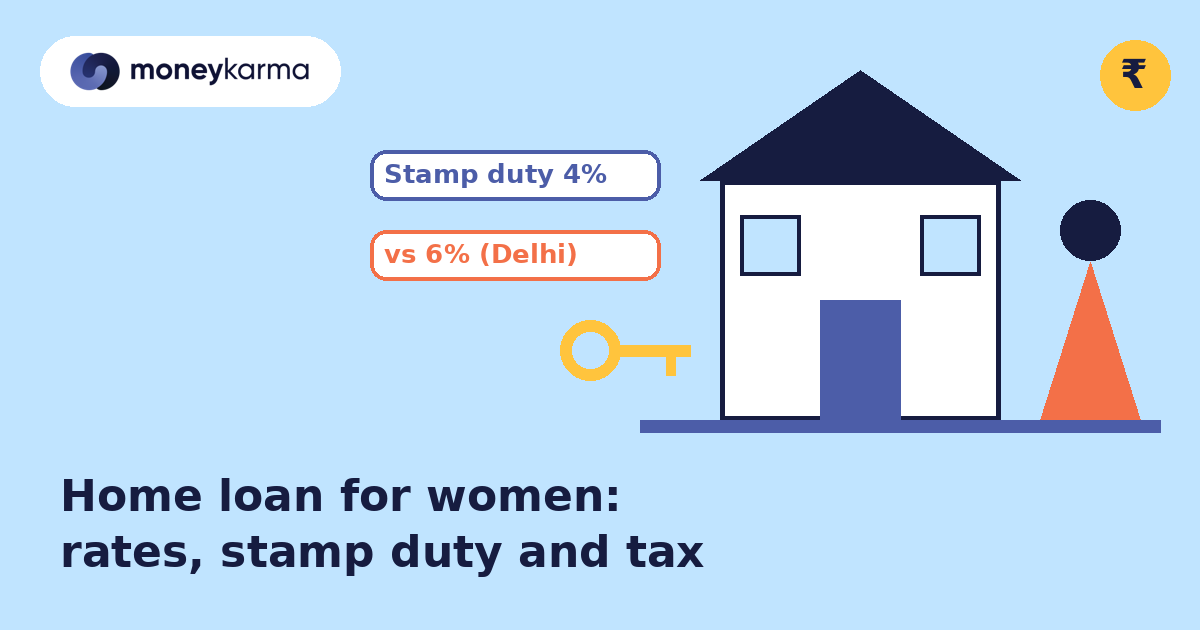
Yes, women can get a cheaper home loan in India, but the bigger saving usually comes from stamp duty, not the interest rate. On lenders' own rate sheets checked on 25 October 2026, the women's concession at the banks that publish one was 0.05% to 0.20%. Registering the home in a woman's name in Delhi, by contrast, cuts stamp duty from 6% to 4%, which is ₹1.6 lakh on an ₹80 lakh flat. This guide comes from MoneyKarma, India's home loan platform with 90+ lenders. Not a lender.
Key takeaway: Check your state's stamp duty rule before you decide whose name goes on the deed. A 1% to 2% stamp duty cut is worth far more than a 0.05% rate cut, and in Telangana and Karnataka there is no women's concession at all.
Do women get a lower home loan interest rate?
Some lenders publish one, many don't. Here is what we found on lenders' own rate pages on 25 October 2026. All are floating rates linked to the RBI repo rate, which is 5.50% after the 7 October 2026 increase. We don't name lenders.
| Lender type | Rate for women | Rate for other borrowers | When it applies |
|---|---|---|---|
| Public-sector bank A, women-only scheme | 7.25% to 8.50% | 7.45% to 9.00% (regular scheme) | Women borrowers only |
| Public-sector bank B | 7.45% | 7.50% | Best credit grade, loans ₹50 lakh to ₹1 crore |
| Public-sector bank B | 7.50% | 7.55% | Best credit grade, loans up to ₹50 lakh |
| Public-sector bank C | 7.95% | 8.00% | Salaried, credit score 700 to 749 |
| Public-sector bank C | 7.40% | 7.40% | Credit score 825 and above (no gap) |
| Public-sector bank D | 0.05% off | Standard rate | Only for credit scores below 725 |
The women's discount is real but small, and at two of these banks it disappears for the best credit scores. Public-sector bank C gives it only if the house is owned by the woman, alone or jointly. Public-sector bank A's women-only scheme starts at 7.25%, which matched the lowest home loan rate open to any borrower that we found on 25 October 2026. Private banks we checked publish one rate band for men and women. You can compare home loan interest rates across Indian lenders on MoneyKarma.
What is a 0.05% concession worth?
On a ₹64 lakh loan over 20 years, 7.45% instead of 7.50% lowers the EMI from ₹51,558 to ₹51,362. That is ₹195 a month, or ₹46,918 over the full term. The 0.20% gap at public-sector bank A is bigger: ₹51,362 against ₹50,584, so ₹778 a month and ₹1.87 lakh over 20 years.
Which states charge women less stamp duty?
Stamp duty is a state levy paid at registration, and the home loan doesn't cover it. Rates below are for a sole buyer of a home, from official and published state tables checked on 25 October 2026.
| State | Men | Women | Saving on an ₹80 lakh home |
|---|---|---|---|
| Delhi | 6% | 4% | ₹1.6 lakh |
| Haryana (urban) | 7% | 5% | ₹1.6 lakh |
| Uttar Pradesh (up to ₹1 crore) | 7% | 6% | ₹80,000 |
| Maharashtra (Mumbai) | 6% | 5% | ₹80,000 |
| Rajasthan | 6% | 5% | ₹80,000 |
| Telangana (Hyderabad) | 5.5% plus 1.5% transfer duty | Same | Nil |
| Karnataka (Bengaluru) | Same for all | Same | Nil |
Delhi's revenue department states the 6% and 4% rates directly. Uttar Pradesh widened its 1% rebate for women from homes up to ₹10 lakh to homes up to ₹1 crore by a notification dated 29 July 2025. Delhi charges 5% on a joint deed with a man. Confirm the current rule with the sub-registrar before you book.
Should you register the home only in a woman's name?
It saves the most stamp duty, but think it through. If your spouse's income pays for it, clubbing rules can apply to any rent, and a sole owner alone decides a future sale. Many couples choose joint ownership with the woman as first-named owner, which in several states still gets part of the concession.
How does a joint home loan with your spouse save tax?
Under section 22 of the Income-tax Act, 2025, which applies from 1 April 2026, each owner of a self-occupied home can deduct up to ₹2 lakh a year of home loan interest under the old tax regime. If both spouses co-own the home and pay the EMI from their own income, each can claim their share.
On a ₹64 lakh loan at 7.45% over 20 years, interest in the first year is about ₹4.72 lakh. One owner can claim only ₹2 lakh of it. Two co-owners splitting it equally can claim up to ₹4 lakh between them. For a spouse in the 30% slab, the extra ₹2 lakh deduction is worth ₹60,000 a year before cess. Under the new regime, interest on a self-occupied home isn't deductible.
A joint loan also adds the second income to eligibility. The flip side: both of you are liable for the full EMI, and a missed payment hits both credit scores.
Can a single woman get a home loan?
Yes. No male co-applicant is needed. A single woman is assessed on income, existing EMIs, credit score and the property's value, like anyone else. RBI caps the loan at 90% of the home's value up to ₹30 lakh, 80% above ₹30 lakh to ₹75 lakh and 75% above ₹75 lakh, so plan for at least that much of your own money plus stamp duty.
If your income alone falls short, a parent or sibling can join as co-applicant, usually also as co-owner. MoneyKarma's home loan eligibility guide shows how lenders work out the amount.
A worked example: Ananya buys an ₹80 lakh flat in Noida
Ananya, 32, is a salaried engineer in Noida with a credit score of 790. She and her husband Rohit are buying an ₹80 lakh flat. These are MoneyKarma calculations using the standard reducing-balance EMI formula and the rates above.
| Choice | Effect |
|---|---|
| Register in Ananya's name in Uttar Pradesh | Stamp duty 6% = ₹4.8 lakh instead of ₹5.6 lakh, saving ₹80,000 |
| Loan at 80% of value | ₹64 lakh |
| Women's rate at public-sector bank B (₹50 lakh to ₹1 crore) | 7.45% vs 7.50%, saving ₹195 a month |
| Joint loan, both claim interest (old regime) | Up to ₹4 lakh a year deductible instead of ₹2 lakh |
The biggest saving is the ₹80,000 at registration. In Delhi it would have been ₹1.6 lakh; in Hyderabad, nil.
What should women borrowers check before signing?
- Whether the concession needs the woman to be sole owner, first-named owner or simply a co-borrower.
- Whether the lower rate applies to your credit score band. At two of the banks above, the best-score borrowers get no extra discount.
- The full cost, not just the rate: processing fee, legal and valuation charges, and stamp duty on the mortgage. MoneyKarma's home loan charges and eligibility page lists them.