What You'll Learn
- Which sections of the Income-tax Act, 2025 replace the old home loan deductions
- How much you can claim on interest and on principal, under the old and new regimes
- How joint home loans and let-out homes change the numbers
- A worked example on a ₹60 lakh loan
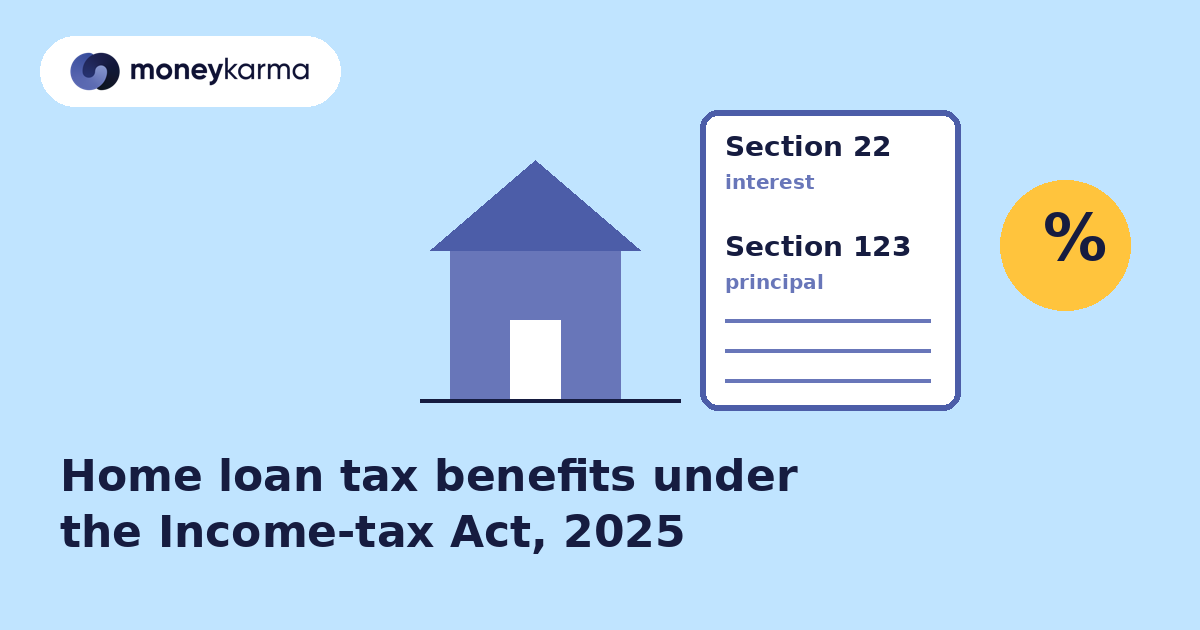
The Income-tax Act, 2025 came into force on 1 April 2026, so the familiar Section 24(b) and Section 80C have new numbers. Home loan interest is now deducted under section 22, capped at ₹2 lakh a year for a self-occupied home. Principal repayment counts toward the ₹1.5 lakh deduction under section 123, read with Schedule XV. Both apply only if you choose the old tax regime. This guide explains the rules with a worked example. It comes from MoneyKarma, India's home loan platform with 90+ lenders. Not a lender.
Key takeaway: The limits haven't changed, only the section numbers. On a self-occupied home under the old regime, you can claim up to ₹2 lakh of interest under section 22 and up to ₹1.5 lakh of principal under section 123. Under the default new regime, there's no deduction for a self-occupied home.
What changed for home loans under the Income-tax Act, 2025?
Very little in substance. The new Act rewrote and renumbered the 1961 law, and the old "assessment year" and "previous year" are now a single "tax year". For home loan borrowers, the mapping looks like this:
| What you claim | Income-tax Act, 1961 | Income-tax Act, 2025 | Limit (old regime) |
|---|---|---|---|
| Interest on a loan to buy or build a self-occupied home | Section 24(b) | Section 22(2)(a) | ₹2 lakh a year |
| Interest on a loan to repair or renovate | Section 24(b) | Section 22(2)(b) | ₹30,000 a year |
| Interest before possession | Section 24(b) | Section 22(1)(c) | Five equal instalments, within the cap |
| Principal, stamp duty and registration | Section 80C | Section 123 and Schedule XV | ₹1.5 lakh a year, shared |
If you see an article citing Section 24(b) for the 2026-27 tax year, it's using the old numbering.
How much home loan interest can you claim under section 22?
For a home you live in, section 22 allows interest up to ₹2 lakh a year, as long as you meet two conditions. The loan must be for buying or building the home, and construction must be completed within five years from the end of the tax year in which you borrowed. You also need an interest certificate from your lender.
If either condition fails, or the loan is for repairs or renovation, the cap is ₹30,000 a year. The ₹2 lakh ceiling is also the total across all your self-occupied homes, not per home.
Interest paid before you get possession isn't lost. You add it up and claim it in five equal parts, starting in the year the purchase or construction is completed. Each part counts inside the ₹2 lakh cap.
How much principal repayment can you claim under section 123?
The principal part of your EMI qualifies as a payment for buying or building a house under section 123 and Schedule XV. So do stamp duty, registration fees and transfer costs, in the year you pay them.
The ₹1.5 lakh limit is shared with your provident fund, life insurance premiums, ELSS and similar items. If your EPF already uses ₹90,000, only ₹60,000 is left for principal.
Repairs or additions made after the completion certificate, or after you've moved in, don't count.
Worked example: a ₹60 lakh home loan
Rohan, a salaried buyer in Hyderabad, took a ₹60 lakh loan for 20 years to buy a ready flat he lives in. We've assumed a rate of 8.0%, which gives an EMI of ₹50,186. In his first year, about ₹4.75 lakh of his EMIs is interest and about ₹1.27 lakh is principal. These are MoneyKarma calculations using the standard reducing-balance formula; the rate is an illustrative assumption.
| Item | Paid in year 1 | Deduction allowed (old regime) |
|---|---|---|
| Interest | ₹4.75 lakh | ₹2 lakh (section 22 cap) |
| Principal | ₹1.27 lakh | ₹1.27 lakh, if his other section 123 items leave room |
| Total | ₹6.02 lakh | Up to ₹3.27 lakh |
If Rohan is in the 30% slab, ₹3.27 lakh of deductions cuts his tax by about ₹1.02 lakh including 4% cess. That's an illustrative figure; surcharge, other deductions and the rebate rules change the real number.
Old regime or new regime?
Under the new regime, which is the default, Rohan gets no interest or principal deduction for his self-occupied flat, but the slab rates are lower and the standard deduction is higher. Which works out better depends on his income and his other deductions. Run both before you file, or ask a tax adviser.
Does a joint home loan double the tax benefit?
It can. If you and your spouse are both co-owners and co-borrowers and both pay the EMI, each of you can claim up to ₹2 lakh of interest and up to ₹1.5 lakh under section 123, in proportion to your share. On Rohan's loan, a couple sharing 50:50 could each claim about ₹2 lakh of the ₹4.75 lakh interest, so ₹4 lakh between them.
Being a co-borrower without being a co-owner usually isn't enough. Make sure both names are on the sale deed and that each person's share of the EMI is paid from their own account.
What if you let the home out?
For a let-out home, section 22 doesn't cap the interest you deduct from rent. If that creates a loss, the old regime lets you set off up to ₹2 lakh against salary or other income in the year, and carry the rest forward. Under the new regime, the rules on setting off a house property loss are stricter. Because these rules interact with your other income, this is a good case to check with a tax adviser.