What You'll Learn
- What a home loan pre-approval is, what it costs and how long it stays valid, from lenders' own pages checked on 28 October 2026
- The documents salaried and self-employed buyers need
- How much a ₹75,000 monthly salary can borrow for a ₹70 lakh flat in Pune
- What can still go wrong after you are pre-approved
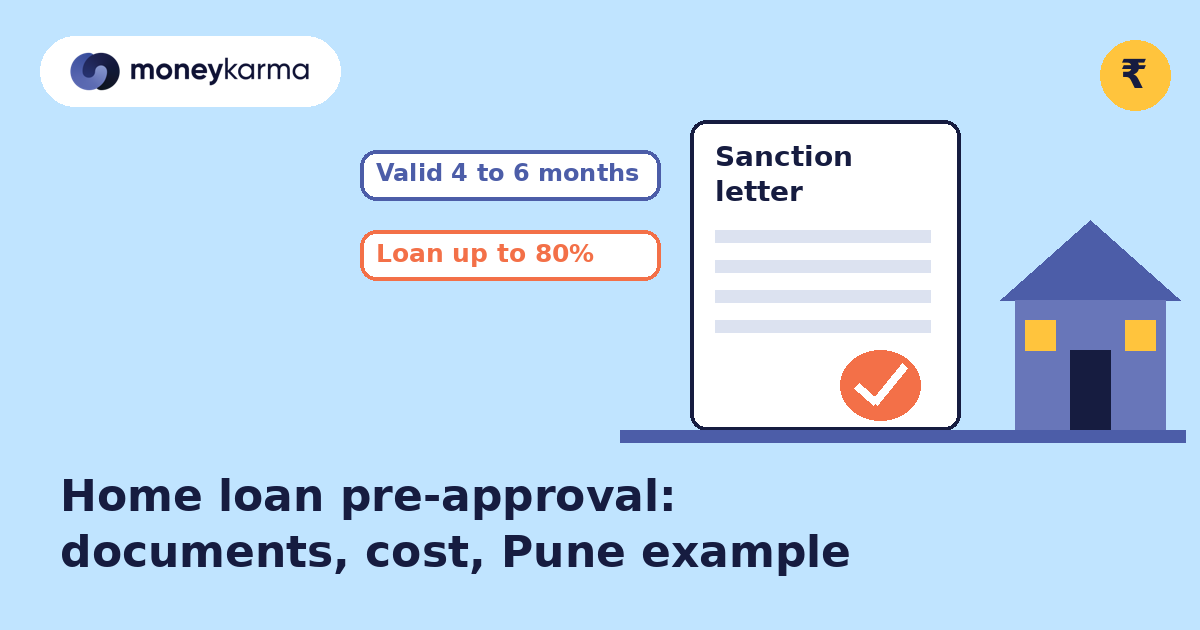
A home loan pre-approval is a lender's in-principle sanction based on your income and credit profile, given before you choose a property. On lenders' pages checked on 28 October 2026, one public-sector bank keeps it valid for 4 months and charges ₹8,500 plus tax upfront, and a private bank gives select existing customers 6 months to identify a property. For a buyer earning ₹75,000 a month and eyeing a ₹70 lakh flat in Pune, the property value, not the salary, sets the limit: about ₹56 lakh. This guide comes from MoneyKarma, India's home loan platform with 90+ lenders. Not a lender.
Key takeaway: Get pre-approved when you start shortlisting flats, not after you pay a booking amount. It tells you your real budget, and a pre-approval valid for 4 to 6 months covers a normal house hunt.
What is a home loan pre-approval?
It is a sanction of a loan limit before the property is final. The lender checks your income, existing loans, age and credit score, then issues a letter with the amount it is prepared to lend. A public-sector bank's page says this lets you "negotiate with the Builder/Seller confidently". The property checks come later.
Is a pre-approval the same as a final sanction?
No. A private bank's FAQ says you can generate the sanction letter before you pick a property, but at disbursement you still submit the property documents and anything else the sanction letter asks for. The lender's legal and technical checks on the flat can still reduce or stop the loan.
How long is a pre-approval valid and what does it cost?
Here is what lenders' own pages showed on 28 October 2026:
| Lender | Validity | Fee |
|---|---|---|
| Public-sector bank C | 4 months from the date of issue | ₹8,500 plus tax upfront, non-refundable; the balance of the processing fee is recovered after sanction |
| Public-sector bank S | Not stated on the page | Non-refundable processing fee as applicable to the home loan, collected at sanction |
| Private bank X | 6 months to identify a property (select existing customers) | Not stated on the page |
Past the validity date you need a fresh assessment. And once you have an offer, RBI's Key Facts Statement rules require the lender's KFS to stay valid for at least three working days, giving you time to compare.
What documents do you need for a home loan pre-approval?
A public-sector bank lists these for its pre-approved loan:
- Application form with passport-size photographs.
- KYC: none needed if your savings account with the bank is already KYC-compliant; otherwise proof of identity (PAN, passport, driving licence or voter ID) and proof of address.
- Bank statements for the last 6 months for all your accounts.
- If you have any other loan, its statement for the last year.
- Salaried: salary slips or a salary certificate for the last 3 months, and Form 16 for 2 years or income tax returns for the last 2 financial years.
- Self-employed: income tax returns, balance sheet and profit and loss account for the last 3 years, business address proof and business licence details.
Property papers are not needed at this stage. At public-sector bank C you submit them within the 4-month validity.
How much home loan can I get on a ₹75,000 salary in Pune?
Take Ishaan, 31, a salaried software tester in Pune with a net take-home pay of ₹75,000, no other loans and a credit score above 800. He has his eye on a ₹70 lakh flat. These are MoneyKarma calculations using the standard reducing-balance EMI formula; Ishaan's profile is an illustration.
Two limits apply, and the lower one wins.
Limit 1: the property value
RBI caps home loans above ₹30 lakh and up to ₹75 lakh at 80% of the property value. On ₹70 lakh that is ₹56 lakh, so Ishaan needs ₹14 lakh of his own (about ₹14.3 lakh with registration), plus stamp duty and registration. Maharashtra's registration fee table caps the registration fee at ₹30,000, which is what a ₹70 lakh flat attracts; stamp duty depends on the property's location, so check it with the state's registration department before you budget.
Limit 2: his income
Public-sector bank C lets salaried borrowers with net monthly income of ₹50,000 to under ₹1 lakh commit up to 65% of it to total deductions including the new EMI. We also show a more cautious 50% budget, our illustration.
| EMI budget | 20 years at 7.25% | 30 years at 7.25% | 20 years at 8.00% |
|---|---|---|---|
| 65% of ₹75,000 = ₹48,750 | ₹61.68 lakh | ₹71.46 lakh | ₹58.28 lakh |
| 50% of ₹75,000 = ₹37,500 | ₹47.45 lakh | ₹54.97 lakh | ₹44.83 lakh |
At the bank's limit, income supports more than ₹56 lakh, so the 80% cap decides. A ₹56 lakh loan at 7.25% costs ₹44,261 a month over 20 years, 59% of his pay, or ₹38,202 over 30 years, about 51%.
Why does your credit score matter at pre-approval?
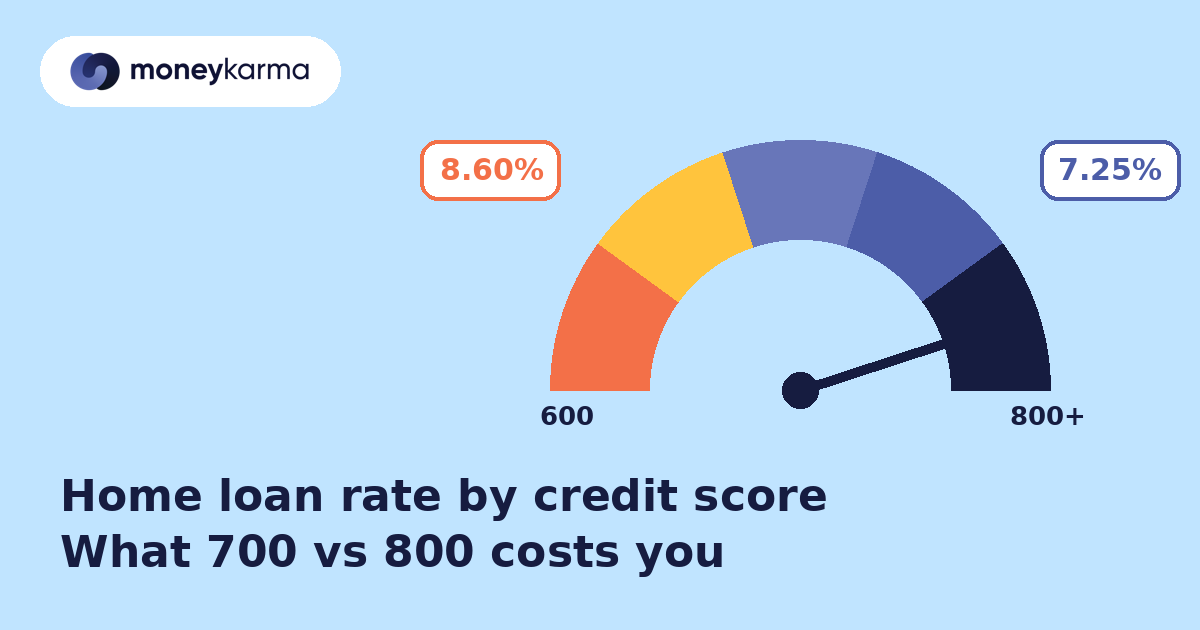
Because it sets your rate (see today's home loan interest rates by lender). At the public-sector bank with the lowest rate we found on 28 October 2026, salaried borrowers pay 7.25% with a score of 800 or more, 7.50% at 750 to 799 and 8.00% at 700 to 724. On Ishaan's ₹56 lakh over 20 years, 7.50% adds ₹852 a month and 8.00% adds ₹2,580.
How does the pre-approval process work, step by step?
- Check your credit report and fix errors before you apply.
- Work out your budget: down payment, stamp duty, registration and an EMI you can carry.
- Collect the documents above.
- Apply to two or three lenders and compare the sanctioned amount, rate and fees. MoneyKarma's home loan eligibility page explains how lenders work out the amount.
- Shortlist flats within your sanctioned limit and the validity period.
- Submit the property papers; the lender runs legal and technical checks and issues the final sanction.
Most lenders publish no standard turnaround; a complete file helps most.
What can go wrong after a pre-approval?
- The flat fails the lender's legal or technical check, or is valued below the price.
- Your income, job or credit score changes before final sanction.
- You take a new loan or credit card EMI, which cuts what you can borrow.
- The rate moves. Repo-linked loans reset with RBI's repo rate, so a pre-approval does not lock your rate.
Can you claim tax benefits in the first year?
Yes, once the flat is yours. Under section 22 of the Income-tax Act, 2025, interest on a loan for a self-occupied home is deductible up to ₹2 lakh a year under the old tax regime. Ishaan's first-year interest on ₹56 lakh at 7.25% is about ₹4,01,757, so he would hit the cap.