What You'll Learn
- How a plot loan, a construction loan and a composite (plot plus construction) loan differ
- Why a plot-only loan usually costs more and runs shorter than a home loan
- How stage-wise construction disbursement works, and what you pay while the house is going up
- A worked example on a ₹40 lakh plot and a ₹60 lakh build, with the EMI math shown
Yes, you can borrow to buy a plot, but a plain plot loan is usually the costlier route. If you plan to build a house on the land, a composite loan that covers the plot and the construction in one sanction is often priced closer to home loan rates and runs for longer. The catch is a build-within deadline you have to meet. This guide compares the three products side by side and works through the numbers. It comes from MoneyKarma, India's home loan platform with 90+ lenders. Not a lender.
Key takeaway: Buy land you mean to build on with a composite loan if you can commit to a construction timeline. Take a plot-only loan only if you're not sure when you'll build, and expect a higher rate, a shorter tenure and, generally, no home loan tax benefits until the house exists.
Plot loan vs home loan: what's the difference?
A home loan funds a house, finished or under construction. A plot loan funds land only. Lenders see bare land as riskier security, because it's harder to value and to sell if a borrower defaults, and they price it that way.
In practice there are three products, and the names vary a little from lender to lender:
| Product | What it pays for | Typical features |
|---|---|---|
| Plot-only loan | Land only, no house yet | Lower share of the price funded, shorter tenure, higher rate band |
| Construction loan | Building a house on land you already own | Paid out in stages as work progresses, priced like a home loan |
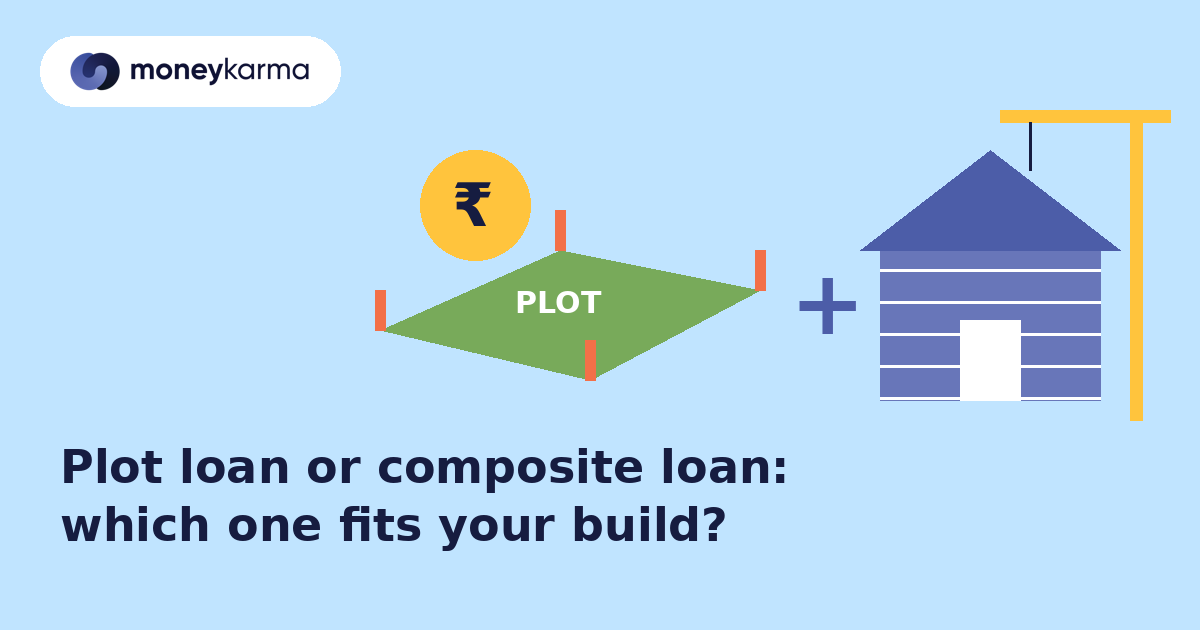
| Composite loan | Plot purchase plus construction, one sanction | Plot paid first, construction in stages, build-within deadline |
The labels are how we group the products, not regulatory categories.
Can I get a home loan to buy a plot?
Not a standard home loan, which needs a house built or being built. You can get a plot loan or a composite loan instead, from public-sector banks, private banks and housing finance companies.
Expect a plot-only loan to differ from a home loan in four ways:
- Rate: usually higher. A public-sector bank's plot product we reviewed in October 2026 listed rates around 9.40% to 9.85%. By comparison, the lowest starting home loan rate in MoneyKarma's 9 October 2026 check was 7.00%, also at a public-sector bank, for top profiles.
- Amount funded: often a smaller share of a plot's value than of a home's.
- Tenure: often shorter than the 20 to 30 years common on home loans.
- Conditions: usually a residential plot with clear title inside approved limits, and often a build-within condition. The product we reviewed set five years.
What about tax benefits on a plot loan?
Under the Income-tax Act, 2025, in force from 1 April 2026, section 22 carries over the old Section 24(b) interest deduction (up to ₹2 lakh a year for a self-occupied home under the old tax regime). Principal repayment sits under section 123 with Schedule XV, the successor to the old Section 80C. Both depend on a residential house. A plot on its own generally doesn't qualify. Once construction is complete, interest paid before completion can be claimed in five equal yearly instalments under section 22, starting with the year of completion. Check your case with a tax adviser.
How does a composite loan work?
A composite loan is a single sanction for the land and the house, approved up front on the plot's value, the building plan and the construction estimate. The plot portion is paid first, usually to the seller at registration. The construction portion is released in stages as the house goes up.
Because it's tied to a home being built, it's usually priced closer to home loan rates. In exchange, you commit to a timeline, often one to three years to start building, depending on the lender. Miss it, and the agreement may let the lender reprice the loan or apply other terms. Read that clause before you sign.
How does a home construction loan disbursement work?
Whether it's a standalone construction loan or half of a composite loan, the money comes in tranches. A typical sequence:
| Stage | What the lender checks before releasing money |
|---|---|
| Foundation and plinth | Approved plan, site visit, plinth complete |
| Walls and columns | Engineer or valuer confirms progress |
| Roof slab | Structure complete to roof level |
| Finishing | Plastering, flooring, fittings, near completion |
Stages and amounts vary by lender. Each release usually follows a site inspection, so plan for that gap before you pay your contractor.
You pay interest only on what's been disbursed. Until the full amount is out, many lenders collect interest-only payments, often called pre-EMI. Full EMIs, covering principal and interest, start once disbursement is complete or on a date in your agreement.
A worked example: ₹40 lakh plot, ₹60 lakh house
Ankit, a salaried engineer in Pune, wants a ₹40 lakh plot and a ₹60 lakh house on it, ₹1 crore in all. He'll borrow ₹75 lakh and put in ₹25 lakh.
The rates below are illustrative assumptions, not offers: 9.5% for a plot-only loan and 8.5% for a composite loan or a construction loan. All EMIs are MoneyKarma calculations using the standard reducing-balance formula.
Route 1: separate plot loan, then a construction loan
- Plot loan: ₹30 lakh at 9.5% over 15 years. EMI about ₹31,327.
- Construction loan later: ₹45 lakh at 8.5% over 20 years. EMI about ₹39,052.
- Combined EMI once both are running: about ₹70,379 a month.
Route 2: one composite loan
- Composite loan: ₹75 lakh at 8.5% over 20 years. EMI about ₹65,087 a month once fully disbursed.
| Route | Amount borrowed | Monthly EMI (illustrative) |
|---|---|---|
| Plot loan + construction loan | ₹75 lakh | ₹70,379 |
| Composite loan | ₹75 lakh | ₹65,087 |
| Difference | Same | ₹5,292 a month |
Part of that gap is tenure: 15 years on the plot loan against 20 on the composite. Strip that out and the rate alone still matters. At the same 15 years, ₹30 lakh at 9.5% costs ₹1,785 a month more than at 8.5%, or about ₹3.21 lakh over the loan's life.
What Ankit pays during construction
Under the composite loan, the ₹30 lakh plot portion goes out first. At 8.5%, interest on that is about ₹21,250 a month. When the first ₹15 lakh construction tranche is released, the outstanding amount is ₹45 lakh and monthly interest rises to about ₹31,875.
So Ankit has to budget for pre-EMI and rent at the same time, for as long as the build takes.
Plot plus construction loan: how to pick a lender
There's no single best lender for every plot. Compare:
- Rate on the composite loan, and how it changes if you miss the build deadline
- Share of plot value and total cost the lender will fund
- Build-within period, and whether it means starting or finishing construction
- Disbursement stages, and whether you can choose full EMI from the start
- Processing and inspection charges, listed in the Key Facts Statement
Self-employed? See home loans for the self-employed. You can also compare home loan types and run your numbers on the EMI calculator.