What You'll Learn
- What fixed home loan rates cost against floating rates on 27 October 2026, using lenders' own rate pages
- How far rates would have to rise before a fixed rate saves you money
- What switching from floating to fixed costs, and what RBI's reset rules let you ask for
- Who should still consider a fixed rate
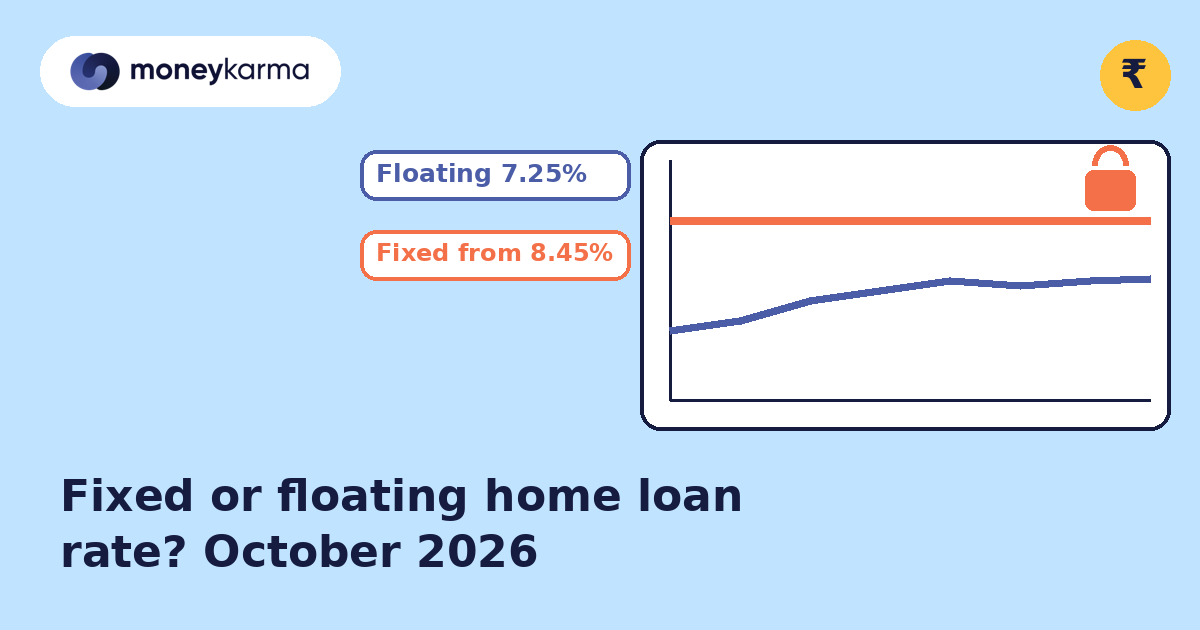
For most borrowers, staying on a floating rate is still the cheaper choice after RBI's 7 October 2026 repo hike. On 27 October 2026 the lowest floating home loan rate we found was 7.25% at a public-sector bank, while fixed rates on lenders' own pages started at 8.45% and ran to 14.00%. On a ₹50 lakh, 20-year loan, a fixed rate of 8.95% costs ₹5,307 a month more than 7.25% floating from day one. This guide comes from MoneyKarma, India's home loan platform with 90+ lenders. Not a lender.
Key takeaway: A fixed rate only pays off if floating rates rise by more than the fixed premium and stay there. At 7.25% floating against 8.95% fixed, that means a 1.70-point rise, almost seven repo hikes of 0.25% each.
Should I switch to a fixed home loan rate after the repo hike?
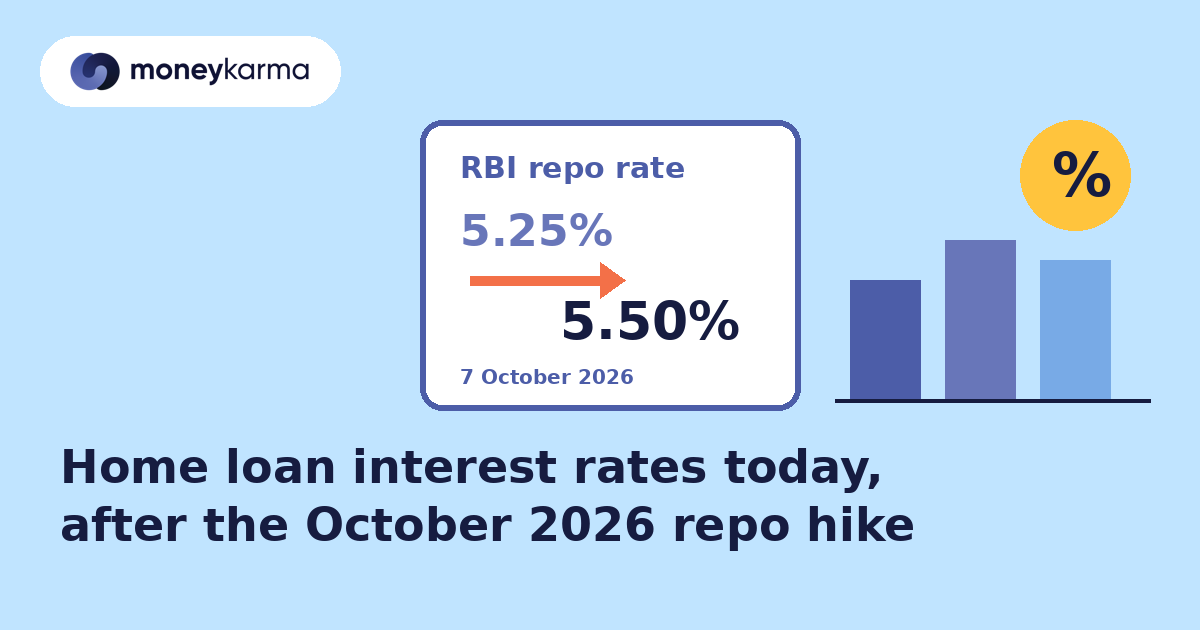
Probably not, unless you need a fixed EMI more than you need the lowest cost. RBI raised the repo rate by 0.25 percentage points to 5.50% on 7 October 2026. Several public-sector banks passed this on to repo-linked loans from 8 October, so a floating EMI on a ₹50 lakh, 20-year loan went up by roughly ₹761 a month for every 0.25%.
That is small next to the fixed premium. On the pages we checked, fixed rates sat 1.20 to 6.75 points above the lowest floating rate, and you pay that gap every month whether rates rise or not. Unless you expect rates to rise by more than the premium and stay up for years, a fixed rate is insurance that costs more than the risk it covers.
How much more do fixed home loan rates cost today?
Here is what lenders' own pages showed on 27 October 2026. Floating rates are for the strongest credit profiles.
| Lender | Lowest floating rate | Fixed rate | How long it stays fixed |
|---|---|---|---|
| Public-sector bank A | 7.25% (score 800+, salaried) | 11.70% to 12.90%, by loan size | Reset after 3 years |
| Public-sector bank B | 7.45% (score 800+) | 8.45% (tenure up to 10 years) or 8.95% (above 10 years) | Not stated; card valid 1 October to 31 December 2026 |
| Private bank X | 8.75% | 8.90% to 9.15% for 24 to 60 months; 10.90% to 11.20% for the full term | Rates valid till 31 October 2026 |
| Private bank Y | Not compared | 14.00% | Not stated |
Many "fixed" loans are fixed for only two to five years, then reset. Ask how long the rate is locked.
For the full dated table by lender, see fixed vs floating home loan rates on moneykarma.com.
How far would rates have to rise for fixed to win?
Take Ananya, 34, a salaried engineer in Pune borrowing ₹50 lakh over 20 years with a credit score above 800. These are MoneyKarma calculations using the standard reducing-balance EMI formula; the rate paths are illustrations, not forecasts.
| Rate path over 20 years | Highest EMI | Total interest |
|---|---|---|
| Floating stays at 7.25% | ₹39,519 | ₹44.85 lakh |
| Floating rises 0.25% a year for 4 years, then stays at 8.25% | ₹42,314 | ₹50.73 lakh |
| Floating jumps 1.00% for 3 years, then falls back to 7.25% | ₹42,491 | ₹46.57 lakh |
| Floating rises 1.50% within 2 years, then stays at 8.75% | ₹43,929 | ₹54.64 lakh |
| Fixed at 8.95% for the full term | ₹44,826 | ₹57.58 lakh |
In every path, floating costs Ananya less. Even if it climbs to 8.75% and stays there for 18 years, she pays about ₹2.9 lakh less than at 8.95% fixed, and her highest EMI stays below the fixed one. A three-year spike of one point adds only about ₹1.7 lakh of interest, because her EMI comes back down with the rate.
What does the fixed premium cost each month?
At 8.95% fixed the EMI is ₹44,826; at 7.25% floating it is ₹39,519. That is ₹5,307 a month, or about ₹12.7 lakh over 20 years if rates never move. Bank B's 10-year option is cheaper to hold: 8.45% fixed against its own 7.45% floating costs about ₹2,639 a month more on ₹50 lakh over 10 years.
What does it cost to switch from floating to fixed?
Each lender sets its own switching charge, and it must appear in your sanction letter. Lenders' pages on 27 October 2026:
| Lender | Floating to fixed charge | Other conditions |
|---|---|---|
| Public-sector bank A | ₹5,000 plus GST | Up to 2 switches in the loan; credit score above 700 and no overdue |
| Public-sector bank D | 0.25% of the loan amount, minimum ₹250, maximum ₹25,000, plus GST | Applies to EMI-based retail loans |
| Private bank Y | 1% of the outstanding principal, minimum ₹10,000 | Fixed back to floating costs 2% |
On Ananya's ₹50 lakh loan, that is about ₹5,900 at bank A, ₹14,750 at bank D with 18% GST, and ₹50,000 at bank Y.
Can you prepay a fixed-rate home loan for nothing?
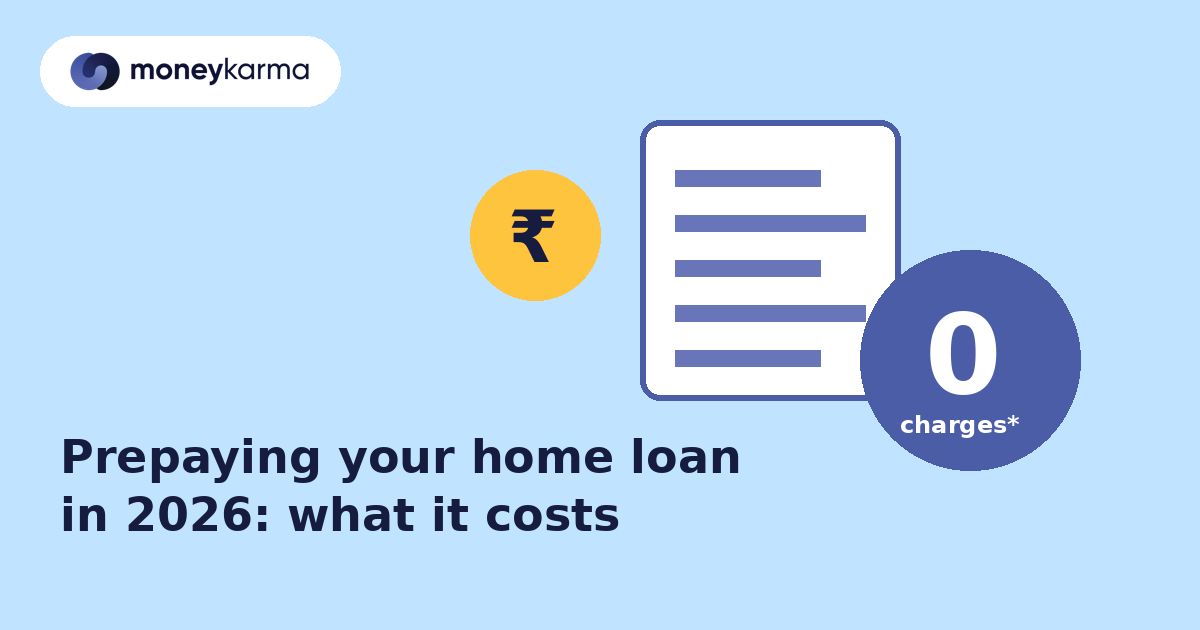
Not always. RBI rules bar prepayment charges on floating-rate loans to individuals for non-business purposes, and RBI's Pre-payment Charges Directions of 2 July 2025 extend this to all regulated lenders for loans sanctioned or renewed from 1 January 2026. Fixed-rate loans are outside that protection. Private bank Y's schedule lists a 2% charge on fixed-rate loans, of the "outstanding principal / amount prepaid".
What do RBI's reset rules let you ask for?
RBI's circular on floating-rate resets for EMI loans (18 August 2023, updated 1 October 2025) says:
- They must explain how a benchmark change affects your EMI or tenure, at sanction and when it happens.
- At a reset, you can choose a higher EMI, a longer tenure, or a mix of both.
- You can prepay in part or in full at any time during the loan.
- All charges for switching from floating to fixed must be disclosed in your sanction letter.
- You get a statement every quarter showing principal and interest paid, EMIs left and the annual rate.
One detail changed: since 1 October 2025, offering a switch to fixed at reset is the lender's option under its board-approved policy, not a right you can insist on. Many lenders still offer it, so ask.
When does a fixed rate make sense?
A fixed rate can be worth it if:
- Your EMI is already near half your take-home pay and a ₹3,000 to ₹5,000 rise would break your budget.
- You can get a short fixed period priced close to floating, like private bank X's 2 to 5 year option, only 0.15 points above its own floating rate.
- You are near retirement and want a known EMI to the end.
For everyone else there is a cheaper hedge: stay floating and set aside the ₹761 a month that each 0.25% rise would add. If rates fall, you benefit straight away.