What You'll Learn
- What pre-EMI is and how it differs from paying full EMI on an under-construction home
- What each option costs on a ₹60 lakh loan with stage-wise disbursement
- How the five-instalment tax rule treats interest paid before possession
- What to check in the builder's payment plan and your sanction letter
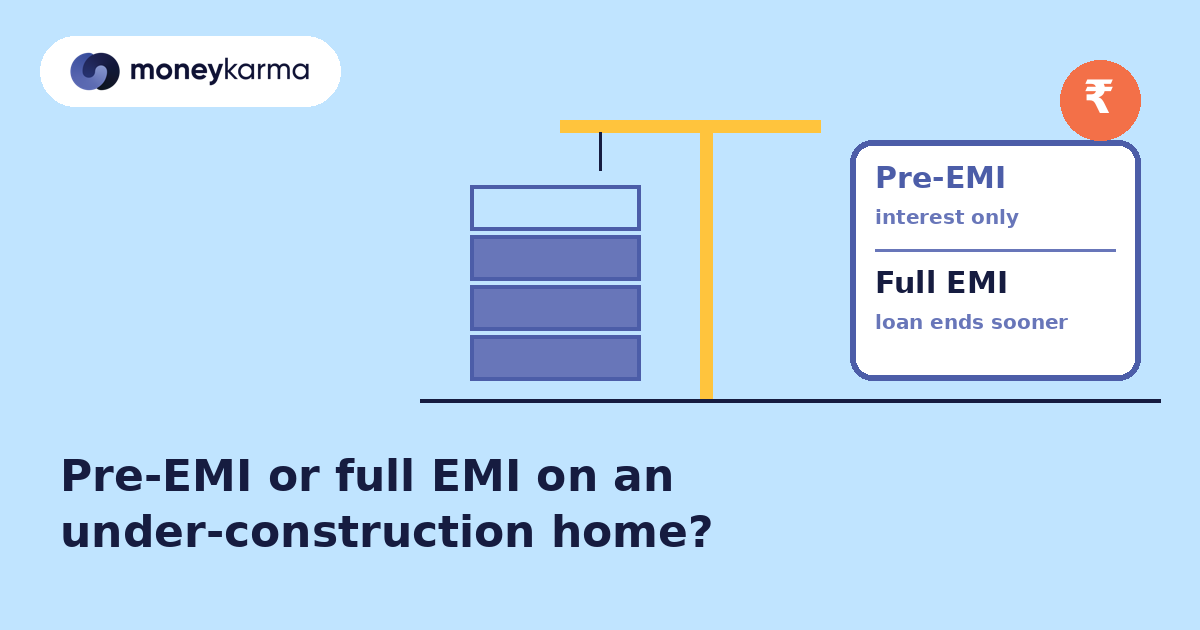
When you buy an under-construction flat, the bank releases the loan in stages as the builder hits construction milestones. Until possession, you can either pay pre-EMI, which is interest only on the amount released so far, or start full EMI straight away. Pre-EMI keeps your monthly outgo low while you may also be paying rent, but your loan doesn't shrink and you end up paying more interest overall. Full EMI costs more each month and finishes the loan sooner. This guide works through both with real numbers. It comes from MoneyKarma, India's home loan platform with 90+ lenders. Not a lender.
Key takeaway: On a ₹60 lakh loan at 8% released over 30 months, pre-EMI cost about ₹10.7 lakh more in total interest than full EMI in our example, and pushed the last EMI 30 months further out. Pre-EMI makes sense mainly when rent plus EMI would stretch your budget.
How does a home loan work for an under-construction property?
For a ready flat, the lender pays the seller in one go. For a project still being built, it pays the builder in parts, linked to stages such as foundation, each slab, brickwork and possession. Most builders publish this as a construction-linked payment plan.
Interest runs only on what has been released. If your sanction is ₹60 lakh but the bank has paid out ₹12 lakh so far, you pay interest on ₹12 lakh.
Before each release, most lenders ask for a demand letter from the builder and may send someone to check progress. Keep copies of every demand letter and receipt. You'll need them for tax and if there's ever a dispute about the stage reached.
What is pre-EMI and how is it calculated?
Pre-EMI is the monthly interest on the disbursed amount, paid until the final disbursement or possession. None of it reduces your principal.
The formula is simple: disbursed amount × annual rate ÷ 12. At 8%, ₹12 lakh disbursed means about ₹8,000 a month. Once ₹24 lakh is out, it rises to ₹16,000. With the full ₹60 lakh disbursed, it would be ₹40,000 a month, still interest only.
Your regular EMI starts after the last tranche, and the full tenure, say 20 years, starts from that point. So if the builder takes three years, your loan effectively runs for 23.
Pre-EMI or full EMI: which costs less?
Kavya has booked a ₹75 lakh flat in Pune that's due in 30 months. She's taken a ₹60 lakh loan for 20 years. We've assumed a rate of 8.0% and five equal disbursements of ₹12 lakh, at months 0, 6, 12, 18 and 24. All figures are MoneyKarma calculations using the standard reducing-balance formula, and the rate and schedule are illustrative assumptions.
| Option | Monthly payment during construction | Monthly EMI after possession | Total interest | Loan ends |
|---|---|---|---|---|
| Pre-EMI, then full EMI | ₹8,000 rising to ₹40,000 | ₹50,186 for 240 months | ₹67.65 lakh | Month 270 |
| Full EMI from the first tranche | ₹10,037 rising to ₹51,306 | ₹51,306 until month 240 | ₹56.91 lakh | Month 240 |
In the full EMI option, the EMI is reset at each tranche so the loan still ends 20 years from the first disbursement. Lenders set this up differently, so ask yours how it calculates EMI on a part-disbursed loan.
Two numbers matter here. Kavya pays about ₹7.20 lakh in pre-EMI over 30 months, none of which cuts her loan. And the pre-EMI route costs about ₹10.74 lakh more in total interest. The monthly gap is smaller than it looks: in the last six months before possession, she'd pay about ₹40,000 on pre-EMI against ₹51,306 on full EMI.
When does pre-EMI make sense?
- You're paying rent until possession, and rent plus full EMI would push your total EMIs past what feels safe.
- You expect a bonus or the sale of another asset that you plan to use to prepay once you move in.
- The project is likely to be delayed and you want to keep cash in hand.
When should you start full EMI?
- You can afford it alongside rent without dipping into savings.
- You want the loan to end on a fixed date, for example before retirement.
- Your lender lets you switch from pre-EMI to full EMI later, so you can start small and move up. Ask whether it charges for the switch.
How are pre-EMI and interest before possession taxed?
Under the Income-tax Act, 2025, in force from 1 April 2026, section 22 covers interest on a home loan. Interest you pay before the tax year in which the home is acquired or construction is completed can't be claimed in those years. Instead, the total is claimed in five equal instalments, starting in the year of completion.
For a self-occupied home under the old tax regime, the combined interest deduction is capped at ₹2 lakh a year, and the pre-construction instalment counts inside that cap, not on top of it. The ₹2 lakh limit also needs construction to be completed within five years from the end of the tax year in which the loan was taken; otherwise the cap falls to ₹30,000.
Here's what that means for Kavya. Her ₹7.20 lakh of pre-EMI becomes five instalments of ₹1.44 lakh. But in her first full year of EMIs, the regular interest alone is about ₹4.75 lakh, already well above ₹2 lakh. So for a self-occupied flat, the pre-construction instalment adds nothing to her deduction in that year. If she lets the flat out, the cap on interest works differently, so she should check with a tax adviser.
Principal repaid after possession can count toward the ₹1.5 lakh deduction for house purchase under section 123 and Schedule XV, shared with other eligible investments. Under the new tax regime, which is the default, there's no interest deduction for a self-occupied home.
What to check before you sign
In the builder's agreement
- The project's RERA registration and the possession date it states
- The stage-wise payment plan, and whether any big payments fall before real construction
- What happens if possession is delayed, including any compensation clause
In your sanction letter and Key Facts Statement
- The rate, the benchmark it's linked to and the spread
- Whether you're on pre-EMI or full EMI, and whether you can switch
- Processing fees and any charges per disbursement or inspection
- The total disbursement period the lender allows
Some builders offer "subvention" plans, where the builder pays your pre-EMI until possession. Read these carefully. If the builder stops paying, the bank will expect you to pay, and your credit score takes the hit if you don't.