What You'll Learn
- What a home loan really costs once fees, insurance and GST are added (lender pages checked 28 October 2026)
- How to read the APR every lender must show you
- When a low fee beats a low rate, and when it does not
- What RBI says about insurance sold with a home loan
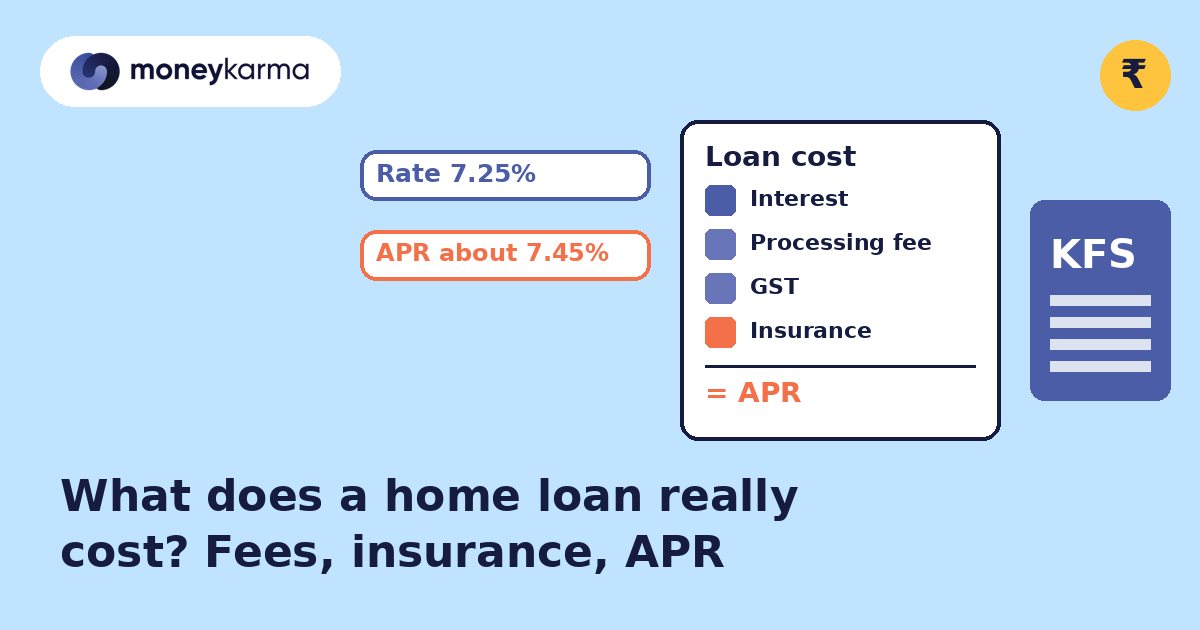
The true cost of a home loan is the interest rate plus every one-time charge, and the single number that captures it is the Annual Percentage Rate (APR) on your Key Facts Statement. On a ₹50 lakh, 20-year loan at 7.25%, the lowest rate we found at a public-sector bank on 28 October 2026, a ₹15,000 processing fee lifts the APR to about 7.29%, a ₹25,000 fee to about 7.32%, and a ₹60,000 insurance premium on top pushes it to about 7.45%. This guide comes from MoneyKarma, India's home loan platform with 90+ lenders. Not a lender.
Key takeaway: Compare home loans on APR, not on the headline rate. Fees and insurance add 0.04 to 0.20 points to the real cost of a ₹50 lakh loan in our examples, and the rate gap between lenders (7.25% against 8.75% on 28 October 2026) still matters far more than the fees.
What is the true cost of a home loan?
It is everything you pay to borrow, in three parts:
- Interest, set by your rate and tenure.
- One-time charges paid to the lender: processing fee, plus GST, and sometimes legal or valuation fees.
- Charges paid to third parties through the lender, mostly insurance premiums.
Your EMI only shows the first. A lender can quote a lower rate and win it back through fees.
What processing fees are lenders charging in October 2026?
Here is what lenders' own pages showed on 28 October 2026. We quote the fee lines as each lender prints them.
| Lender | Processing fee as published | What it means on a ₹50 lakh loan |
|---|---|---|
| Public-sector bank C | Loans up to ₹50 lakh: minimum ₹8,500, maximum ₹15,000; above ₹50 lakh: minimum ₹8,500, maximum ₹25,000; excluding GST | At most ₹15,000 plus GST |
| Public-sector bank S | "50% concession in Card Rate. 100% Waiver in selected cases. T&C Apply." | Ask for the exact amount in writing |
| Private bank X | "0.5% of the loan amount + applicable taxes" | ₹25,000 plus taxes |
| Private bank Y | "Up to 1% of the loan amount or ₹10,000 (whichever is higher) + GST"; ₹5,000 plus GST collected upfront | Depends on the final quote; ask before you apply |
Ask whether the fee is refundable if the loan is rejected; private bank Y's page says its fee is non-refundable and "independent of the outcome". Also ask what it covers. Public-sector bank C's schedule describes a unified fee that includes inspection, valuation and legal fees.
Is GST charged on the processing fee?
Yes. Every fee line above adds GST or taxes on top, so compare GST-inclusive amounts.
How does insurance change the cost of a home loan?
Public-sector bank C states on its home loan page that a "Risk Premium of 0.05% will be levied for customers not obtaining credit insurance cover". On ₹50 lakh over 20 years, 7.30% instead of 7.25% adds ₹152 a month, about ₹36,388 over the full term. The same page says the life cover is a one-time premium based on your age, loan, rate and tenure, that it can be added to the loan at your request, and that part of the premium is refunded if you close the loan early.
Take Rohan, 35, a salaried borrower in Pune with a ₹50 lakh, 20-year loan at 7.25%. These are MoneyKarma calculations using the standard reducing-balance EMI formula; the ₹60,000 premium is an illustrative assumption, not a quote.
| Rohan's choice | EMI | Extra cost over 20 years |
|---|---|---|
| Loan only, no insurance | ₹39,519 | None |
| Skip cover at a lender that adds 0.05% | ₹39,670 | ₹36,388 in extra interest |
| ₹60,000 single premium added to the loan | ₹39,993 | ₹1,13,814 in total, of which ₹53,814 is interest on the premium |
Adding the premium to the loan nearly doubles what the cover costs. If you can pay it upfront, do.
Can a bank force you to buy its insurance with a home loan?
No. In a Lok Sabha answer on 27 July 2026, the Finance Ministry said RBI has directed banks not to resort to compulsory bundling of any product, including insurance, with their own products such as home loans. If a bank needs insurance as a risk mitigant, you must be given the option to buy it from any provider.
What is APR on a home loan and why does it matter?
APR is the annual cost of credit, including the interest rate and all other charges. RBI's Key Facts Statement circular of 15 April 2024 made it compulsory for every retail loan sanctioned on or after 1 October 2024, home loans included. Two rules in it help you:
- Charges the lender collects for third parties, such as insurance and legal fees, must be counted in the APR and shown separately.
- The Key Facts Statement must stay valid for at least three working days, so you have time to compare offers.
Here is how fees and insurance move the APR on Rohan's ₹50 lakh loan at 7.25%:
| Charges paid upfront | APR |
|---|---|
| None | 7.25% |
| ₹15,000 fee | 7.29% |
| ₹25,000 fee (0.5%) | 7.32% |
| ₹50,000 fee (1%, illustrative) | 7.38% |
| ₹15,000 fee plus ₹60,000 premium | 7.45% |
MoneyKarma worked these out as the internal rate of return on the amount you receive, the method in RBI's illustration.
Should you pick the lower rate or the lower fee?
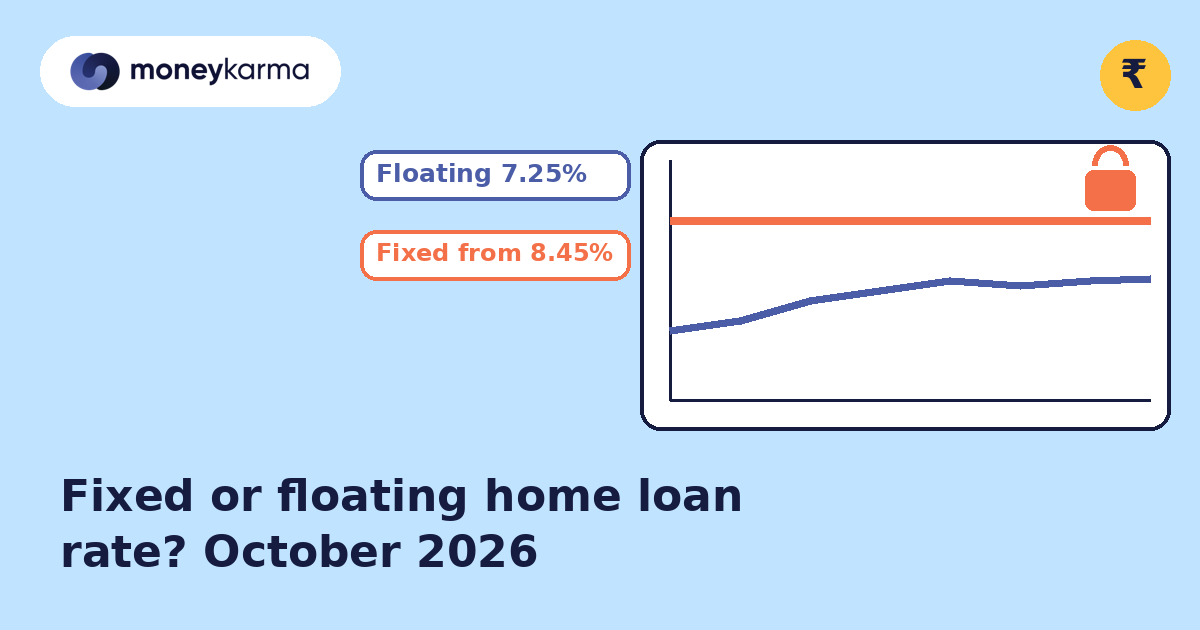
The lower rate, in most cases, because the rate gap between lenders is much bigger than the fee gap. On 28 October 2026 the lowest floating rate at a public-sector bank was 7.25%; private bank X started at 8.75% with a 0.5% fee. On ₹50 lakh over 20 years that is ₹4,667 a month more, and an APR of about 8.82% against 7.29%.
Suppose one offer is 7.25% with a ₹25,000 fee and another is 7.35% with no fee. The 0.10% gap costs ₹304 a month. After five years the two offers have cost almost exactly the same, within ₹400 of each other. So:
- If you expect to prepay, sell or move your loan within five years, take the lower fee.
- If you will keep the loan longer, take the lower rate.
Floating-rate home loans to individuals carry no prepayment charge under RBI rules, so moving lenders later is realistic.
How do you compare the total cost of two home loan offers?
Before you sign:
- Ask each lender for its Key Facts Statement and note the APR.
- Check the fee line: amount, GST, and whether it is refundable.
- List every insurance product offered, its premium, and whether it is added to the loan.
- Ask if the rate changes when you decline insurance, as it does at public-sector bank C.
- Compare APR first, then the EMI, then how long you plan to keep the loan.
You can check today's lender rates on MoneyKarma's home loan interest rates page and the usual charges on the home loan charges and eligibility page.