What You'll Learn
- How much a spouse or parent as co-applicant adds to your home loan eligibility, using a public-sector bank's published income rules checked on 29 October 2026
- A worked example: a couple earning ₹1 lakh a month buying a ₹1.1 crore flat in Mumbai
- How a co-applicant's credit score and existing EMIs change your rate and loan amount
- Who can be a co-applicant, and what joint borrowers can claim in tax
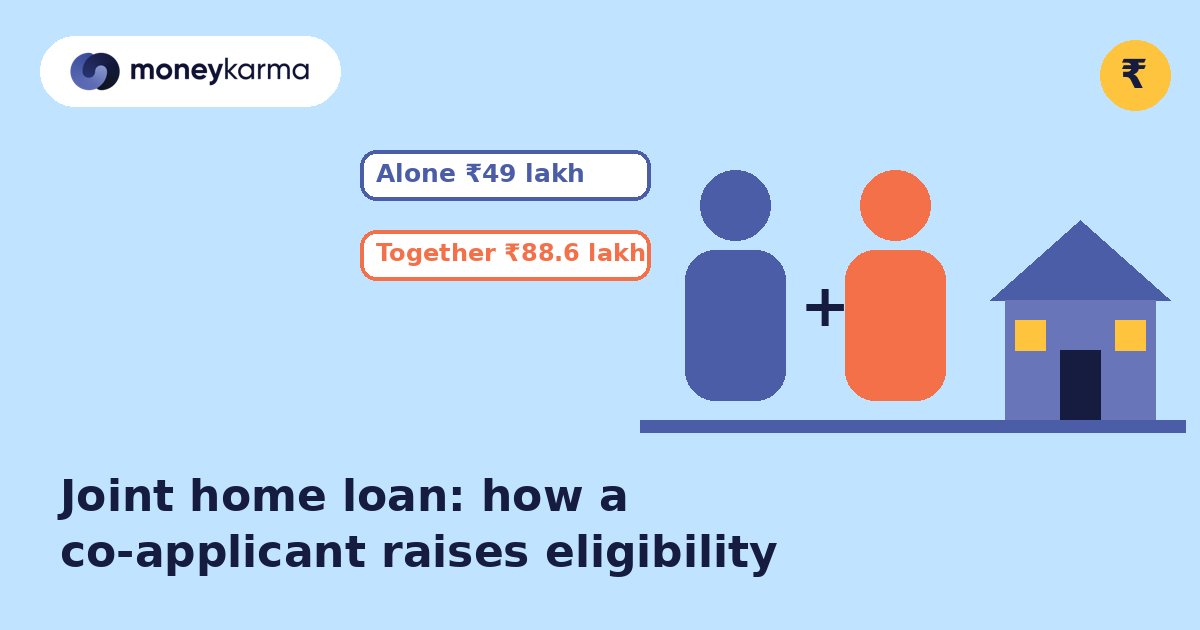
Yes, adding your spouse or a parent as a co-applicant usually raises your home loan eligibility, because the lender counts both incomes and can allow a higher share of the combined pay for EMIs. Under one public-sector bank's rules checked on 29 October 2026, a salaried borrower earning ₹60,000 a month can borrow about ₹49 lakh over 20 years at 7.25%. Add a spouse earning ₹40,000 and the same couple can support about ₹88.6 lakh. The catch: a co-applicant with a weak credit score or a large EMI of their own can pull the rate up or the amount down. This guide comes from MoneyKarma, India's home loan platform with 90+ lenders. Not a lender.
Key takeaway: A co-applicant helps most when they have a steady income, few existing loans and a good credit score. Add them as co-owner too, so both of you can claim tax benefits.
Does adding a co-applicant increase home loan eligibility?
Yes. A public-sector bank's home loan terms say close relatives "can be added as a co-applicant for higher eligibility". Lenders add up the net income of everyone whose income is considered, then apply their repayment limit to the total.
That limit often rises with income. At the same public-sector bank, salaried borrowers can commit this share of net monthly pay to all EMIs, including the new one:
| Net monthly income | Maximum share for all EMIs |
|---|---|
| Below ₹25,000 | 40% |
| ₹25,000 to below ₹50,000 | 60% |
| ₹50,000 to below ₹1 lakh | 65% |
| ₹1 lakh to below ₹2 lakh | 70% |
| ₹2 lakh and above | 75% |
So a couple whose combined income crosses ₹1 lakh moves into the 70% band, and the extra room applies to the whole joint income, not just the second salary.
How much home loan can a couple earning ₹1 lakh get in Mumbai?
Meet Priya, 32, and Karan, 34, a salaried couple in Mumbai. Priya takes home ₹60,000 a month and Karan ₹40,000. They like a ₹1.1 crore flat in the city. These are MoneyKarma calculations using the standard reducing-balance EMI formula and the bank's limits above; the couple and the flat are an illustration.
| Who applies | EMI budget | 20 years at 7.25% | 30 years at 7.25% | 20 years at 8.00% |
|---|---|---|---|---|
| Priya alone (65% of ₹60,000) | ₹39,000 | ₹49.34 lakh | ₹57.17 lakh | ₹46.63 lakh |
| Priya and Karan (70% of ₹1 lakh) | ₹70,000 | ₹88.57 lakh | ₹1.03 crore | ₹83.69 lakh |
| Together, if Karan pays a ₹10,000 car EMI | ₹60,000 | ₹75.91 lakh | ₹87.95 lakh | ₹71.73 lakh |
Why the property value still caps the loan
RBI limits home loans above ₹75 lakh to 75% of the property value. On a ₹1.1 crore flat that is ₹82.5 lakh, so Priya and Karan need ₹27.5 lakh of their own, plus stamp duty and registration. Maharashtra's registration fee is capped at ₹30,000; check stamp duty for the flat's location with the state's registration department.
Together they qualify for more than ₹82.5 lakh, so the 75% cap decides. At 7.25% over 20 years the EMI is ₹65,206, about 65% of their joint pay. Over 30 years it is ₹56,280.
Alone, Priya would top out at about ₹57 lakh even over 30 years, and RBI's 80% cap for loans of ₹30 to ₹75 lakh would limit her to a flat of about ₹71 lakh.
What if the co-applicant already has a loan?
Their EMI comes out of the joint budget. With Karan's ₹10,000 car EMI, the couple's 20-year limit at 7.25% drops to ₹75.91 lakh, short of the ₹82.5 lakh they need. They could stretch to 30 years, bring a larger down payment, or close the car loan first.
How does a co-applicant's credit score affect the rate?
It counts. One public-sector bank's page says its rate depends on the loan amount and the credit score of all applicants. At the public-sector bank with the lowest rate we found on 29 October 2026, salaried borrowers pay 7.25% with a score of 800 or more and 7.50% at 750 to 799. On ₹82.5 lakh over 20 years, that difference is ₹1,255 a month, or ₹3.01 lakh over the term.
Before you apply, both of you should pull your credit reports and fix errors. Compare current home loan interest rates by lender to see which bands you fall in.
Do women co-applicants get a lower rate?
At some lenders. A public-sector bank checked on 29 October 2026 charges women borrowers 0.05% less than other borrowers at its top credit grades: 7.45% against 7.50% on loans above ₹50 lakh up to ₹1 crore. On ₹82.5 lakh over 20 years, that is ₹252 a month, about ₹60,480 over the term. Ask how the lender defines a woman borrower, since some link the concession to ownership.
Who can be a co-applicant on a home loan?
Lenders keep the list tight. A public-sector bank allows close relatives: spouse, parents, children and their spouses, siblings and some in-laws. Anyone else can join only if they are a joint owner of the property. Other rules at the same bank:
- A co-applicant must be at least 18; the main borrower at least 21.
- Salaried co-applicants whose income is counted need 1 year in work; self-employed ones need 2 years in business.
- For self-employed income, the bank allows 70% of average net annual income up to ₹6 lakh and 80% above that.
Can a self-employed spouse be a co-applicant without three years of returns?
Often yes, if their business income has a two-year record. At the bank above, two years in business is the minimum for income to be counted. Lenders will still ask for income tax returns and financial statements for that period, so check the exact list with each lender. MoneyKarma's home loan eligibility page explains how lenders assess mixed salaried and business income.
Can a parent be a co-applicant?
Yes, but watch age. The bank above considers borrowers up to 70, so an older parent can shorten the tenure the lender offers and raise the EMI. Ask the lender to show the tenure with and without the parent.
What tax benefits do joint home loan borrowers get?
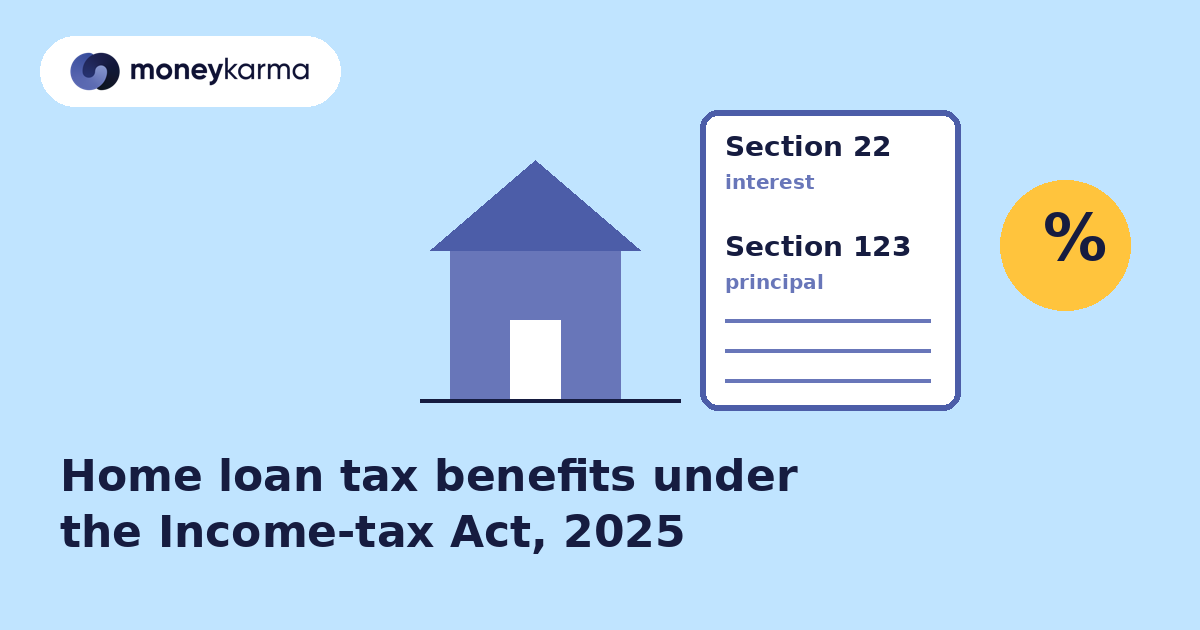
Under the old tax regime, each borrower who is also a co-owner and pays the EMI can claim interest under section 22 of the Income-tax Act, 2025, up to ₹2 lakh a year for a self-occupied home, and principal under section 123, within the ₹1.5 lakh limit. In the first year of Priya and Karan's ₹82.5 lakh loan, interest is about ₹5.92 lakh. One borrower could claim only ₹2 lakh of it; two co-owners sharing the EMI can claim up to ₹4 lakh between them. The new regime gives no interest deduction on a self-occupied home. Check your own case with a tax adviser.