What You'll Learn
- Top-up home loan and personal loan rates for renovation, from lenders' own pages on 24 October 2026
- Which is cheaper for a ₹8 lakh renovation, with the EMI and total interest worked out
- Which banks price renovation at home loan rates, and what changes with a top-up
- The tax rule for renovation interest under the Income-tax Act, 2025
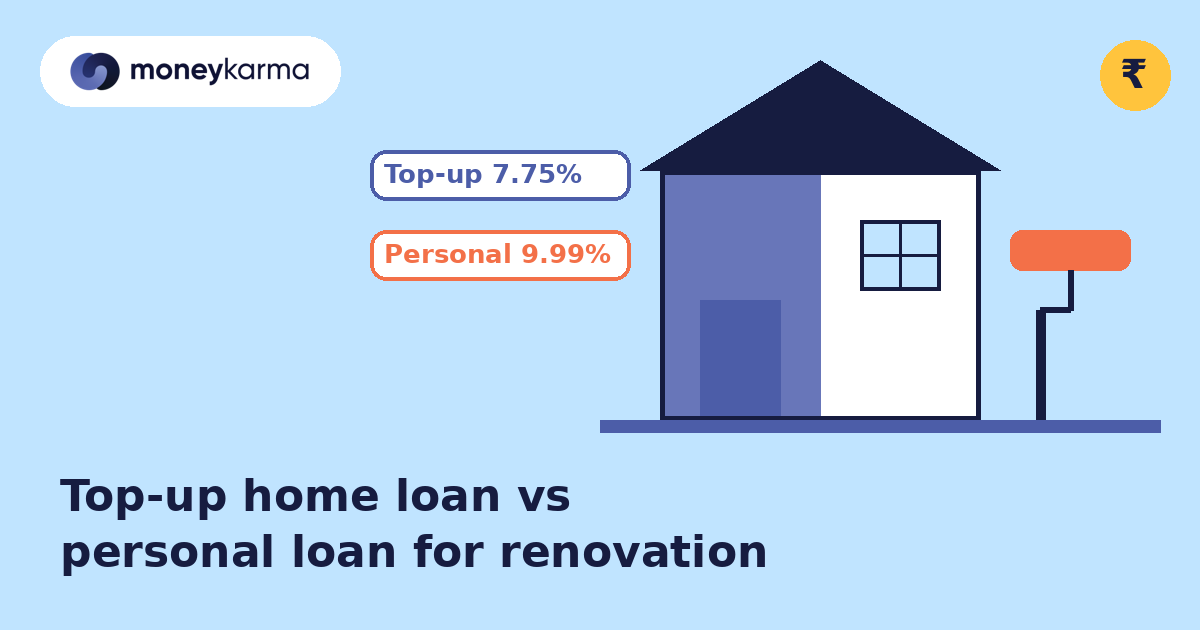
For most people who already have a home loan, a top-up home loan is cheaper than a personal loan for renovation. On lenders' rate pages checked on 24 October 2026, top-ups at public-sector banks start at 7.75% to 8.15% for borrowers with credit scores of 800 or more, while personal loans start at 9.30% at a public-sector bank and 9.99% at two large private banks. The catch is tenure: a top-up stretched over 10 years can cost more interest in total than a five-year personal loan. This guide comes from MoneyKarma, India's home loan platform with 90+ lenders. Not a lender.
Key takeaway: Compare a top-up and a personal loan over the same tenure. On ₹8 lakh over five years, a 7.75% top-up costs about ₹52,000 less interest than a 9.99% personal loan.
Top-up home loan vs personal loan for renovation: which is cheaper?
The top-up, on rate. A top-up is an extra loan on the house that already carries your home loan, so the lender has security and prices it just above your home loan. A personal loan is unsecured, so it costs more and runs shorter.
Here is what lenders' own pages showed on 24 October 2026. Lenders aren't named. All home loan rates here are floating and linked to the RBI repo rate, which is 5.50% after the 7 October 2026 increase.
| Loan | Rate at a good credit score | Where the rate comes from |
|---|---|---|
| Top-up, public-sector bank A | 7.75% salaried, 7.85% non-salaried (score 800+) | Home loan rate plus 0.50% |
| Top-up, public-sector bank B | 8.15% (score 825+) | Home loan rate plus 0.75% |
| Top-up (home loan plus), public-sector bank C | 8.80% to 10.85%, by risk grade | RLLR 8.25% plus 0.55% to 2.60% |
| Top-up or home improvement, public-sector bank D | 9.90% (score 800+) to 10.50% | RLLR 8.35% plus 1.55% to 2.15% |
| Personal loan, public-sector bank B | 9.30% salaried, 9.35% non-salaried (score 800+) | EBLR 8.25% plus 1.05% to 1.10% |
| Personal loan, two private banks | From 9.99%; one shows a range up to 24.00% | Fixed rate, set by profile |
One caution: public-sector bank A's FAQ says its top-up costs 0.20% over the home loan, but its rate sheet says 0.50% at a score of 800 or more. Ask which applies.
Is a home renovation loan cheaper than a top-up?
Often, yes. Some banks treat repair and renovation as a purpose inside their regular home loan scheme. Public-sector bank B lists repair and renovation in the same scheme as its home loans, at 7.40% for scores of 825 or more. Public-sector bank A's housing scheme also covers repair, renovation and extension, and its lowest home loan rate is 7.25%, the lowest we found on 24 October 2026. A private bank prices its renovation loan the same as its home loans, at 8.00% to 13.45%. You can check home loan interest rates across Indian banks on MoneyKarma.
A renovation loan usually asks for more paperwork than a top-up. The private bank wants an estimate of the work from an architect or civil engineer, plus the title deeds and proof that no one else has a charge on the property.
A worked example: ₹8 lakh to redo a kitchen and two bathrooms
Meera, 38, lives in a flat in Pune that she bought six years ago on a home loan. She has a credit score above 800 and needs ₹8 lakh for a new kitchen and two bathrooms. These are MoneyKarma calculations using the standard reducing-balance EMI formula; her profile and the 16% rate are illustrative.
| Option | Rate | Tenure | EMI | Total interest |
|---|---|---|---|---|
| Top-up at public-sector bank A | 7.75% | 10 years | ₹9,601 | ₹3.52 lakh |
| Top-up at public-sector bank A | 7.75% | 5 years | ₹16,126 | ₹1.68 lakh |
| Personal loan at public-sector bank B | 9.30% | 5 years | ₹16,723 | ₹2.03 lakh |
| Personal loan at a private bank | 9.99% | 5 years | ₹16,994 | ₹2.20 lakh |
| Personal loan at 16% (illustrative) | 16.00% | 5 years | ₹19,454 | ₹3.67 lakh |
Over five years, the top-up saves Meera ₹52,088 in interest against the 9.99% personal loan, or ₹868 a month. Stretch it to 10 years and her EMI falls to ₹9,601, but she pays ₹3.52 lakh in interest, more than the personal loan. Compare total cost, not the EMI.
Fees widen the gap. One private bank charges a personal loan processing fee of up to 2%, which is up to ₹16,000 on ₹8 lakh. Public-sector bank A charges 0.25% on its home loans, or ₹2,000 on the same amount.
When does a personal loan make more sense?
A top-up isn't always the right call. A personal loan can be better when:
- You don't have a home loan, or the home is in a co-owner's name who won't join the top-up.
- The work is small, a few lakh, and you'll repay it within two or three years.
- Your home loan is with a lender whose top-up rate is close to personal loan rates. Public-sector bank D's top-up and home improvement rates start at 9.90%, which is above the 9.30% personal loan at bank B.
Also check prepayment terms. RBI rules bar prepayment charges on floating-rate loans to individuals, which covers most top-ups. Many personal loans are fixed-rate, and the private bank above allows foreclosure without a charge only under a specific programme after 12 EMIs.
Who can get a top-up home loan?
You need a running home loan with a clean repayment record. Lenders cap the existing loan and the top-up together at a share of the home's current value, and check your income again.
At public-sector bank A, a top-up can be used for repairs and renovation or for other needs such as education and weddings, and only one top-up can be active at a time. Its rate depends on your credit score: 0.50% over the home loan rate at 800 and above, 0.75% at 750 to 799, 1.00% at 681 to 749 and 3.00% at 680 or below. A weak score can wipe out the advantage over a personal loan, so check yours first.
Can I get a top-up from a different bank?
Usually only with a balance transfer, where a new lender takes over your home loan and adds a top-up. Compare the switching costs on MoneyKarma's home loan balance transfer guide.
Can you claim tax on renovation loan interest?
Sometimes. Under section 22 of the Income-tax Act, 2025, interest on money borrowed to repair, renew or reconstruct a house is deductible from income from house property. For a self-occupied home, interest on a loan for repairs is capped at ₹30,000 a year, inside the overall ₹2 lakh limit, and only under the old tax regime. What counts is how the money is used, not the loan's name, so keep the contractor's bills and the lender's interest certificate.
Meera's first-year interest on the five-year top-up is about ₹57,227. Under the old regime she can claim ₹30,000 of it, worth ₹9,000 at a 30% slab before cess. Check with a tax adviser.